August 2, 2017
Share:


Rue-Morgue: NSFW Exclusive—THE RESTORATION AT GRAYSON MANOR at Fantasia/Frontieres
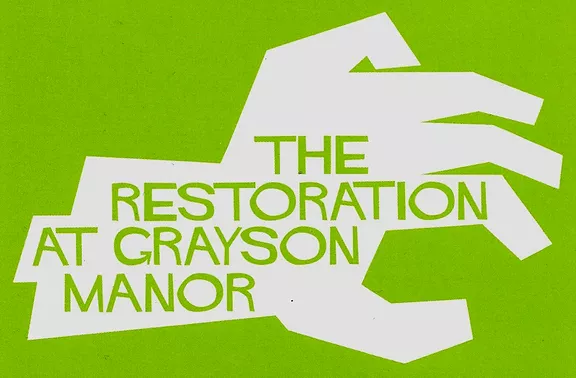
Fantasia/Frontières Exclusive: NSFW concept video and comments for Glass Eye Pix’s THE RESTORATION AT GRAYSON MANOR
Of the 20 feature-film pitches presented during a lengthy session at the Frontières International Co-Production Market at Montreal’s current Fantasia festival, one was especially attention-grabbing. Glass Eye Pix topper Larry Fessenden, director Glenn McQuaid and screenwriter Clay McLeod Chapman offered a vivid combination of animation and live action to sell potential financiers on their project THE RESTORATION AT GRAYSON MANOR, and the latter teaser (which is extremely NSFW) can be seen here exclusively, along with a RUE MORGUE chat with the trio.
THE RESTORATION OF GRAYSON MANOR is about Boyd, a rich young man living a sex-drugs-and-rock-’n’-roll lifestyle, much to the disapproval of his mother, who’s anxious for him to produce an heir. When Boyd loses his hands in an accident, they are replaced by a robotic pair that he can control with his mind. As the proof-of-concept video seen below demonstrates, that’s bad news for a hunky guy who shows up at the family mansion expecting a good time—and our hero’s original, severed hands also make appearances, albeit seen only through Boyd’s eyes as he dreams of them wreaking havoc in the house.
This clip reveals only a few of the unusual elements at play in THE RESTORATION AT GRAYSON MANOR. McQuaid, who previously directed the Glass Eye graverobber opus I SELL THE DEAD, has an enthusiasm for esoteric subgenres within the horror realm, and conceived THE RESTORATION OF GRAYSON MANOR after viewing a YouTube video a few years ago. “It was a French guy, an amputee, sitting at a table, with a mess of wires between him and a robotic hand. The hand was stationary, and he started clenching his eyes and thinking and thinking and thinking, until the hand suddenly started making a fist. The whole idea was that now you can control a robotic appendage with your mind, with your consciousness. So I started to think, well, if you could do that, what would happen if it could be controlled by your unconscious? I wrote a short little story and gave it to Clay, and let him have fun with the script.”
“Glenn gave me free rein,” Chapman says, “and created an architecture where every 10 pages, something terrible has to happen, and it only gets worse.” Although the premise lends itself to an over-the-top treatment, the writer notes, “We’re steering clear of farcical, but there is a bawdy element to it. It’s like a comedy of errors meets Edgar Allan Poe’s ‘The Fall of the House of Usher’ meets TITUS ANDRONICUS meets EVIL DEAD II. We want to marry and smash together all these separate themes and influences, while it intensifies and ratchets up to a place where, once you reach the crescendo, all hell has broken loose.”
“Another great influence is Pedro Almodóvar,” McQuaid adds. “I love his early work like LAW OF DESIRE and WHAT HAVE I DONE TO DESERVE THIS?, and his more popular stuff like WOMEN ON THE VERGE OF A NERVOUS BREAKDOWN. I like how insane his plot twists are; there’s something outrageous in his work that seems to have a global appeal. There could be an argument that his earlier films are works of queer cinema, but I think their appeal is much broader than just to the LGBT community. I like the idea of inserting bizarre behavior by these droll, dry characters to elicit laughs from the audience. It’s going to be very enjoyable to watch these people rip themselves apart, along the lines of THE WAR OF THE ROSES or DEATH BECOMES HER, where the performers go for a nuanced take on despicable behavior. I haven’t seen a movie like this in a long time, and it taps into all of my passions.”
Fessenden responded immediately to the idea of adding killer hands to Glass Eye’s rogues’ gallery, and found that bringing the project to Frontières helped the team get a handle on how to pursue it. “It’s always thrilling to see if we can tackle yet another subgenre we haven’t touched on before, and bring the humanity that we always like to have at Glass Eye. Glenn and I often talk about what he’s up to next, and I get excited about it, because I know it’ll be something fresh. It came together quite fast: deciding to do Frontières, getting in and then saying, ‘Shit, we’ve got to show up with something.’ So we put together this fantastic little concept video, and had a lot of fun doing that.
“The first day of the market,” he continues, “was mostly business, and everybody dryly talking about money—which was fine, because that’s what we were there for. The second day, people started asking about the story, and I could see this team come alive, because we were challenged: How’s this going to work? I think answering those questions will help us make the movie, like, what the hell is the crawling hand going to look like, is it going to be CG or practical, what is this electronic hand all about, what is this guy going to look like without his clothes on? So we had to answer some really tough questions…”
“Some really hard questions!” McQuaid interjects.
“And I believe we really came up with the answers!”
Fessenden also believes that the unique nature of THE RESTORATION AT GRAYSON MANOR has been and will continue to be an asset in getting the movie to the screen. “To our minds, all these disparate elements make perfect sense: The modern technology, the old-school crawling-hand imagery, the Almodóvarian spat between mother and son, the Gothic environment and then the queer sensibility, or should I say, the overt sexuality; everybody’s banging somebody.”
“Any port in a storm!” McQuaid laughs.
“This is such a fantastic mashup,” Fessenden continues, “that when people start to see our enthusiasm, it becomes a movie that kind of presents itself, where you can truly picture it. Now, the funny thing is, everybody’s been picturing something slightly different, according to their personal taste, but that’s perfect. We’re not just making a crawling-hand movie because we want to watch the hands go to town; we want to see how those themes can resonate by mashing up some other genres, and, though Glenn’s voice, be able to bring audiences something new.”
July 27, 2017
Share:
INDIEWIRE: Glass Eye Pix’s “hunky studmuffin” a highlight at Frontières Market
Fantasia’s Frontières Market: The Best Horror Films Yet to Be Made, Including George Romero’s ‘Road of the Dead’
The Montreal festival has become an increasingly important launch point for adventurous genre fare.
Michael Gingold
… among the promising projects seeking the backing to come to a screen near you are:
“The Restoration at Grayson Manor”
Larry Fessenden’s Glass Eye Pix has long been a breeding ground for unconventional horror, and this latest project from writer/director Glenn McQuaid (of the much-praised “I Sell the Dead”) is no different. A combination of Gothic family conflict and modern technology gone awry, it focuses on a wealthy, hedonistic young man whose hands — severed in a tragic accident — are replaced by robotic appendages he can control with his mind.
Black humor is mixed with the shudders here, as evidenced by a proof-of-concept short screened by McQuaid, Fessenden, and co-scripter Clay McLeod Chapman, in which a hunky studmuffin enters an ornate mansion and ascends to an upper floor, stripping naked as he goes, before one of the artificial hands takes him out. Eye-catching animation was also part of this spirited preview, and if half of its energy translates to the feature, it’ll be lots of grisly fun indeed.
July 27, 2017
Share:
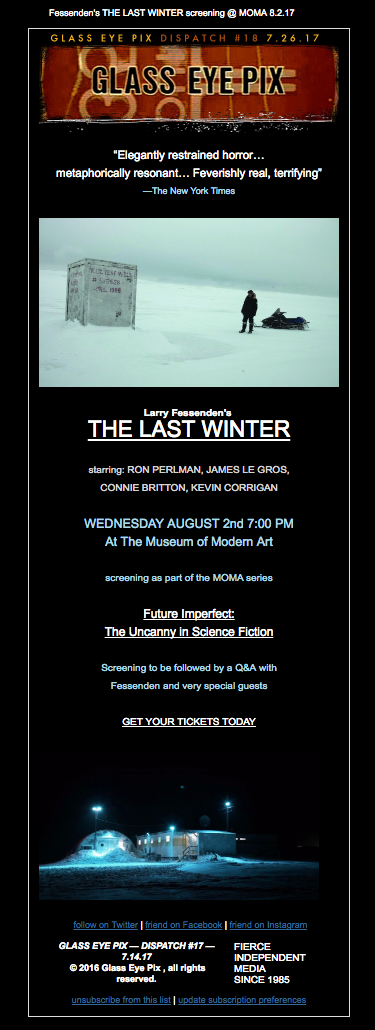
THE FARSIGHTED: “Glass Eye Pix should be very happy to have this in their catalogue”

July 19, 2017
Share:
Graham Reznick’s RAPID EYE among interactive projects highlighted at COMIC CON
GEP pal Graham Reznick presents a trailer for his upcoming interactive project RAPID EYE
at a panel at this year’s Comic Con. Written with and featuring Fessenden, RIPID EYE will blow your gasket.
In the fall of 2017, Eko will be launching a full slate of interactive shows created by a host of creative minds from across fandom and in association with Sony, MGM, and Warner. Come see exclusive footage of the series and chat with the creators about their respective approaches to interactive narratives and what it means to give viewers control of a character’s psyche. The minds behind the shows participating in this discussion will be Graham Reznick (Until Dawn), Sandeep Parikh (The Guild), Lindsay Pulispher (Fear the Walking Dead, True Blood), Milana Vayntrub (This Is Us), Shane Small (creator, Exploding Kittens), and Ben Conrad (GenPop). Moderated by Alex Albrecht (G4techTV).
July 19, 2017
Share:
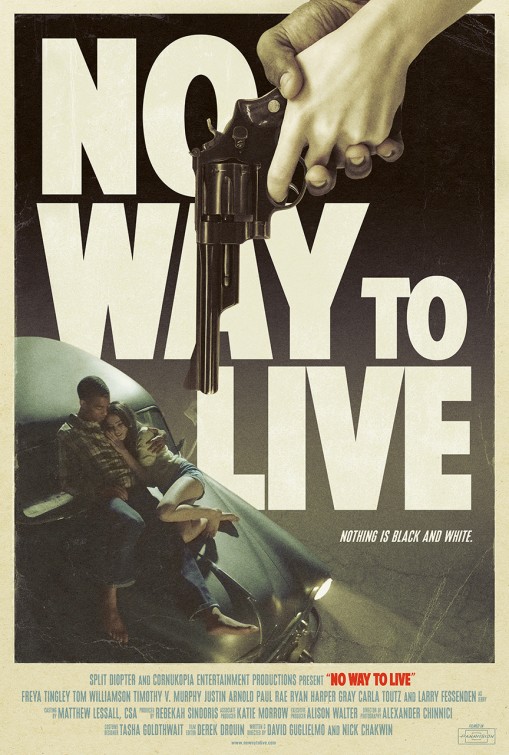
Film Pulse: NO WAY TO LIVE “tightly wound”
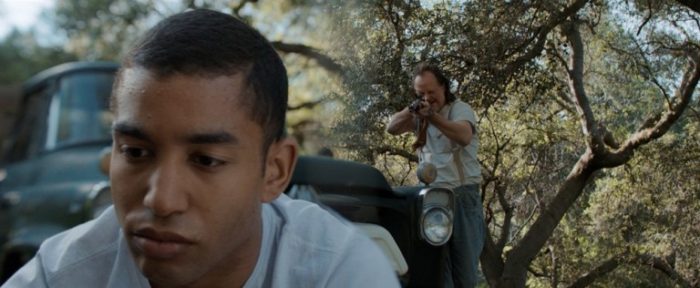
Set in the waning years of the Jim Crow South, Nick Chakwin and David Guglielmo’s No Way to Live presents a tightly wound thriller that delivers a solid noir experience with plenty of twists and turns to keep audiences on their toes.
…
No Way to Live is a nasty little indie thriller that begins as a tragic story of love in a time when it was forbidden but evolves into something more akin to Natural Born Killers than Loving. It’s a surprising turn of events and certainly one worth checking out. Plus, it has a bunch of great split diopter shots and Larry Fessenden as a skeezy redneck…can you guess if he gets killed?
July 17, 2017
Share:
Fessenden offers remembrance of George A. Romero in Talkhouse post

Talkhouse Film Contributors Remember George A. Romero
Larry Fessenden, Brian Trenchard-Smith, Rodney Ascher, Emily Hagins and more remember the much-loved father of the zombie movie.
In the following post, Talkhouse Film contributors and other filmmakers share their tributes to George A. Romero, the father of the zombie movie and the man behind such great movies as Night of the Living Dead, Martin and The Crazies, who passed away yesterday, aged 77.
More remembrances will be added to this post as they come in. Feel free to leave your own tributes and memories in the comments section. – N.D.
Larry Fessenden
Over the years I have often cited George Romero’s Night of the Living Dead as my favorite horror movie. It served as a fulcrum between the old black-and-white horror films produced by Universal, featuring iconic monsters like Frankenstein and Dracula, and the more modern, despairing, angry and confrontational cinema of the ’60s and ’70s. I saw Living Dead on TV late one night and as a kid, I couldn’t tell when it had been made because it was still black-and-white, but I knew something was different. I knew the genre had grown up. Later, I was enamored with Martin, another film that grappled with the tension between movie monsters, in this case black-and-white vampire movies, and the very real, disturbing psychological violence of the young protagonist. And with The Crazies, Romero gave us a parable about mass hysteria and government overreach. Even when I could see the filmmaking was awkward and on the cheap, there was an energy and a fierce intelligence to Romero’s films, and their scrappiness felt like an invitation to aspiring filmmakers to just go out and do it. Of course he did make Creepshow, which had a budget and a cast and offered him the opportunity to celebrate his love of the DC comics that had influenced him as a kid. Romero was among a band of horror purveyors who came up in the ’60s and who ushered in a more brutal tone to the genre: Craven, Carpenter, Tobe Hooper — but distinct from his contemporaries, Romero seemed to resonate a conscience even as he relished in extreme gore. It is remarkable that a medium that is so collaborative still tends to convey the personality of the director, and in his films, you can feel George’s humility, thoughtfulness and sardonic anti-establishment sensibility. I often think about how Romero lamented he never really had a Hollywood career, never had it easy making films, no matter how influential and beloved he was. It has stood as a reminder that the embrace of Tinseltown is not the only measure of success in cinema.
Jeffrey Reddick
Few filmmakers have the ability to create a masterpiece right out of the gate, but among those people is George Romero. He will always be known for his first film, Night of the Living Dead. That film captured the essence of what would come to define most of Romero’s work. It tapped into the cultural zeitgeist and was about something. It exploited our fear of “the others” while showing us that “the others” are really us. The movie broke ground by featuring an African-American lead who survives the carnage, only to be killed by people who assume “he’s one of them.” It is a stark statement on the racial conflict at the time … that still strikes a chord today. But “the others” could stand in for any group, and that’s what makes this film timeless. His other work was also about something. Whether it was consumerism in Dawn of the Dead or the desire of the military to weaponize chemicals in The Crazies, Romero always had something to say with his work. And he said it intelligence and humor.
This same intelligence and humor also made George Romero a wonderful person. In a town known for sharks, I’ve never met anyone who didn’t adore George. In addition to his many creative qualities, he was an extremely humble man. I don’t know if he ever fully grasped the impact he had on the film industry. And if he did, it never showed. But his mark on cinema will never be erased. His “light up a room” smile will never be forgotten. And whenever we see a movie with the dead walking the earth, we’ll think of him.
Brian Trenchard-Smith
1968’s Night of the Living Dead was initially banned in Australia, so my first exposure to the genius of George Romero was at the Egyptian Theater in Los Angeles the weekend Dawn of the Dead opened. OMG! Rivers of blood, graphic cannibalism, and social satire! I emerged gobsmacked, then joined the line for tickets to the next session. I had the honor to meet George Romero at the Melbourne Film Festival in 2008. What a charming, urbane, self-effacing man he was. Over canapes and goulash we discussed the mechanics of screen cannibalism. Several of the zombies in his Night of the Living Dead were investors, including a butcher who provided livers, kidneys, and intestines. Chunks of roast ham were the preferred diet for close-ups. At a time of generational change, George Romero pushed the boundaries of graphic bloodshed, infusing political comment along with deep suspicion of authority into his films. He influenced the next generation of film makers, and changed the horror genre forever. Vale, George. You will be missed.
Emily Hagins
I didn’t make a zombie movie as my first feature film just because I loved zombies – I was also heavily influenced by the work and perseverance of George A. Romero. He was one of the first directors I ever studied, and I was so inspired by his innovations and creativity within the genre while making the best of his budget and resources. Because of his films, I started to believe I could make my own independent horror movies as long as I had interesting characters to drive the story. Even though Creepshow has a completely different tone from Night of the Living Dead, they are united by compelling characters, twists on the horror genre, and social commentary that tell us, “Hey, horror movies can be fun and have something to say.” That’s what makes all of Mr. Romero’s films timeless to me. And on a personal note, I’ll never forget the few times we met and I shyly told him how much I looked up to him (and how kind and smart he was in return), or how shocked I was to hear that he knew about my little zombie movie.
Rodney Ascher
Growing up in the ’80s, it was still possible to hear about certain notorious films, (picking up details from unreliable older brothers of school friends or from still photos in old issues of Fangoria) without having any way to actually see them. Dawn of the Dead was one of those for me. I remember being told a story of a man trapped in an elevator facing monsters at every floor. I saw a black-and-white image of someone walking too close to a helicopter rotor. I knew the film had something to do with a shopping mall, which sounded crazy because horror movies take place in the woods or in old castles. I had to see it, but I couldn’t see it.
Life, uh, finds a way.
In my case, it was the AMC Midnight Movie Express. Multiplexes back then typically screened their final shows at 10PM, but one day some unsung hero at the AMC theater chain decided to give the Express a try. It was incredible while it lasted, entire suburban multiplexes screening the greatest hits (and some surprisingly deep cuts) at midnight all weekend long. Chainsaw to Phantom of the Paradise, Heavy Metal to Bloodsucking Freaks. Death Race 2000 to, Yes! Finally! one weekend, Dawn of the Dead. Midnight Movie Express was so special they even created this amazing trailer for it.
That was an incredible time for me and my friends and we had no idea how lucky we were to be in high school with lenient parents and brand new driver’s licenses during the brief window it lasted. Almost all the movies screened were fun in their way, some of them simply for the audacity with which they trampled over taboos, while others were genuinely inspired films that I still count as among my favorites. Dawn of the Dead is clearly in the latter category. I knew going in that it was going to be an incredibly gory zombie film, but what I didn’t know was that it was going to be a sometimes comic, sometimes tragic portrait of a country in perpetual civil war. I didn’t know that it would introduce me to four characters as real as friends or portray a newsroom in a state of chaos and panic as hilarious and horrifying as anything in Network (or happening live today.)
I was just learning how much I could learn from these movies.
We’re still learning from them.
RIP George A. Romero
Calvin Lee Reeder
Night of the Living Dead is public domain. It used to be called Night of the Living Flesh Eaters but when the title card was changed the distributor forgot to copyright it. So Romero made no money. NO MONEY on fucking Night of the Living Dead. But other people made money, lots of other people. I guess some folks will read that and think the lesson is “Copyright and lawyer up.” That’s valid. But for me, it says the business is full of non-creative money vampires. They’re gonna find a way to suck your blood if you have a lawyer or not. And if the objective is to make money alone, then chose the path of the non-creative money vampire. They sleep ironically well.
But if you’re a creative person, you don’t have a choice. It’s a life sentence. George Romero served a beautiful life sentence and if you’re reading this, you don’t need me to tell you how important he is. He knuckled up, he pressed on, he fought the vampires with zombies and carved out a place in the movies that didn’t exist before. George Romero is resilience. If you make movies, you need that more than anything else. It’s a different world than the one Romero came up in, but you could say that about Jesus too. I’ve only read six pages of the Bible, but I’ve watched Romero my whole life. I still want to be just like him.
Clay Liford
If George Romero isn’t the biggest early influence on my filmmaking career, he’s certainly in the top 10. My little-seen first feature, A Four Course Meal, is a direct product of someone loving Creepshow way too much. Calling it an homage may be leaning on the charitable side. Romero invented the space in my brain for horror-comedy. To that point, he basically invented the space which accepts that horror films can talk about stuff other than jumps and screams, Dawn of the Dead being the first socially conscious horror film I ever saw. In fact, that movie means so much to me, it motivated the one and only “movie pilgrimage” I ever made. I was in Pittsburgh on a job, working 18-hour days. We had one day off, mostly to do laundry. But I saw the time as an excuse to visit the Monroeville Mall, clearly the most important mall in cinema history. It took my some spelunking, but I made off with a few pristine copies of the Monroeville Mall map. Some people look at my innocuous map and wonder why I have such an item on prominent display at my home. Others, the cool ones, totally get it.