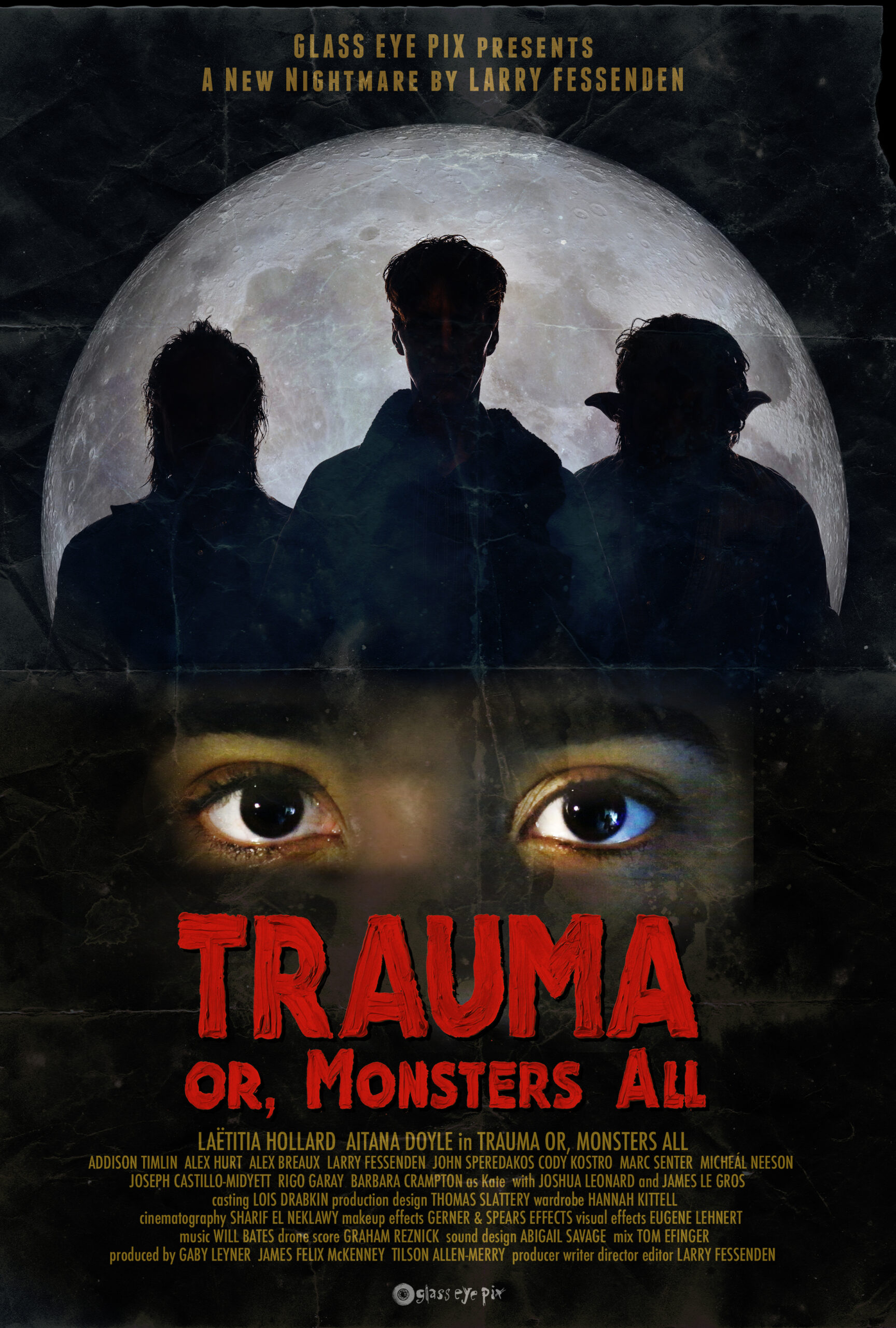
TRAUMA or, Monsters All
Larry Fessenden (2026 118 mins, Arri Alexa, 1:85)
Laëtitia Hollard, Aitana Doyle, Addison Timlin, Alex Hurt, Alex Breaux, Larry Fessenden, John Speredakos, Cody Kostro, Marc Senter, Micheál Neeson, Joseph Castillo-Midyett, Rigo Garay, Barbara Crampton as Kate with Joshua Leonard and James Le Gros
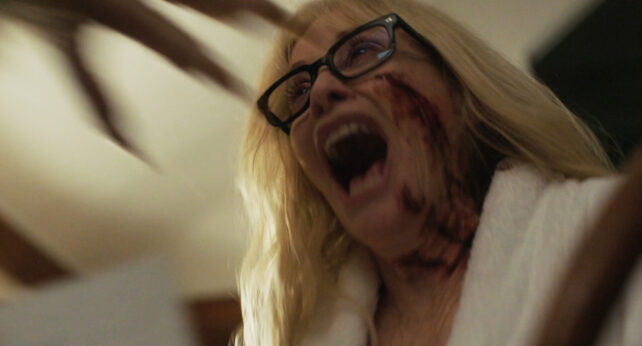
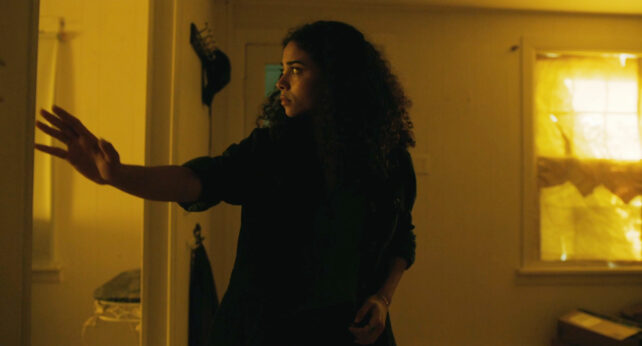
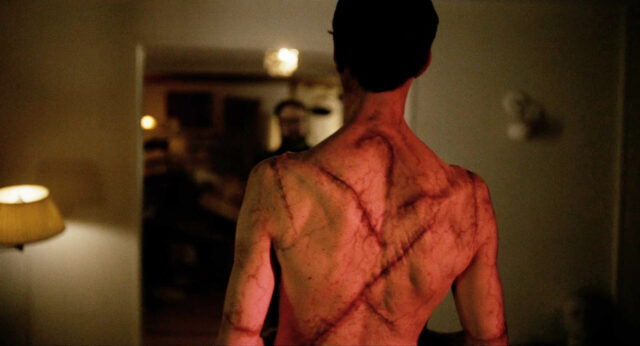
When visiting writer Cassandra asks: “Are There Monsters Outside my Window” in the local paper, the answer leads to a traumatic showdown in the quiet town of Talbot Falls.
ScreenAnarchy
J Hurtado, April 12, 2026
Overlook 2026 Review: TRAUMA, OR MONSTERS ALL Brings A Thirty Year Project Full Circle
It’s been a little over thirty years since indie horror godfather Larry Fessenden burst into the consciousness of the underground with his sideways vampire epic, Habit. In the decades since then, he and his Glass Eye Pix production house have shepherded some of American horror’s most unique storytellers to the big and small screen as a producer while still managing to take time to direct his own idiosyncratic features challenge the present notions of what horror can be in these tumultuous times.
It took almost twenty years for Fessenden to return to his monstrous reimaginings with 2019’s Frankenstein riff, Depraved and 2022’s wolf man story, Blackout. With this Mad Monster Party trio of existential horrors now out in the world, he is here to cap it all off with his own Avengers assemble moment in Trauma, Or Monsters All, premiering at this year’s Overlook Film Festival.
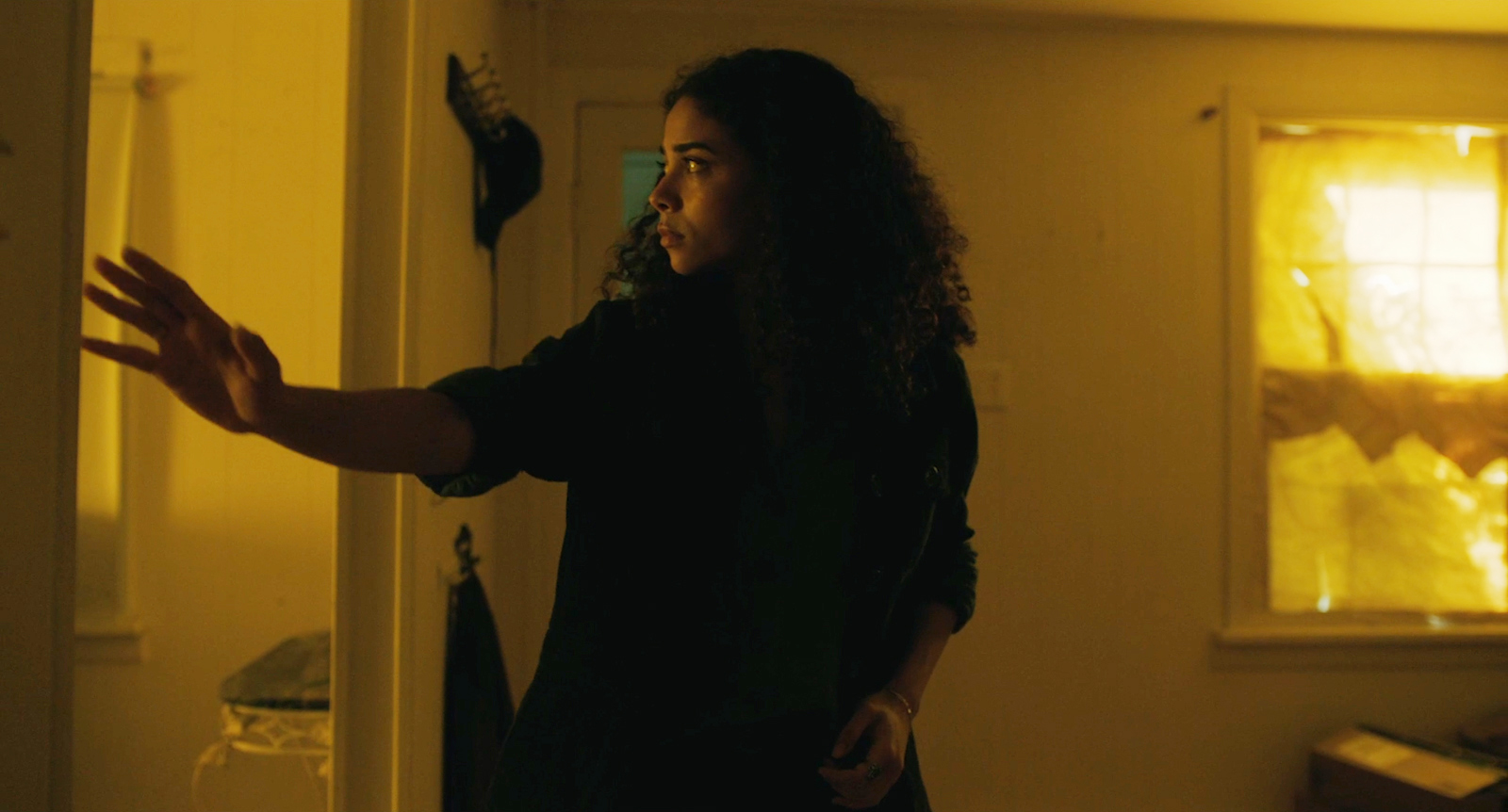
Trauma puts us in the shoes of author Cassandra (Laëtitia Hollard, The Pitt), who has rented a cheap farmhouse in Talbot Falls in upstate New York to focus on her upcoming book about famed scientist, George Washington Carver. One night while milling about in her house, she notices a strange man doing strange things outside of the strange house next door, which sends her down a research rabbit hole.
In an effort to exorcise her frantic curiosity, Cassie writes a piece for the local paper questioning whether there may be real life monsters in the woods that surround Talbot Falls. Her neighbors’ unusual behavior has her under the impression that not only is the town’s werewolf legend more than just a scary story, but perhaps a Frankenstein’s monster might be his keeper. The town doesn’t take kindly to an outsider digging through their dirty laundry, and before long out come the pitch forks, putting Cassie and her obsessions in new and unexpected danger.
Fessenden’s horror stories have always taken an askew glance at the genre, reading into the subtext of the classics to hew closer to the spirit of the stories and the way they’ve always commented on the human condition. Trauma, Or Monsters All is no different, only this time it’s not only the things that go bump in the night that get put under the microscope, it’s also those who would hunt them down.
The collective trauma in Talbot Falls erupts after Cassandra’s article riles up the town and, as the title says, makes monsters of everyone. While the town around her disintegrates into a swirling mass of paranoia and persecution, our old friends Adam (Alex Breaux’s creature from Depraved), Charley (Alex Hurt’s werewolf from Blackout), and Sam (Fessenden’s forlorn vamp from Habit), are monsters left seeking the most human thing of all, connection.
In order to complete his story, Fessenden not only brings back his classic monsters, but also populates Trauma, Or Monsters All with fellow indie horror icons, including returning Talbot Falls attorney Kate (Barbara Crampton), as well as a couple of other blink and you’ll miss them cameos from some of the genre’s most exciting up-and-comers. But Trauma is less indulgent than you might think (though not entirely free of that quirk), for the first time centering the story around a human protagonist who unwittingly stirs up a hornet’s nest in a place she doesn’t really feel welcome.
If you’re a fan of the filmmaker, Trauma, Or Monsters All will be like sweet mana from horror heaven. It’s every inch a Fessen-film, with frequent digressions and monologues that may or may not move the story forward, but also no shortage of blood and gore, with much of it inflicted mercilessly upon fan favorite characters. Three decades after he started this story, Larry Fessenden remains indie horror’s most singular visionary. He may not have imagined his saga ending this way – and it does seem to be a pretty definitive ending, but it’s hard to imagine any other conclusion for this story that marries so many of his consistent obsessions.
Eye For Film
Jennie Kermode, April 12. 2026
Three years ago, Larry Fessenden told me that he wanted to make a film which brought together all the monsters – the troubled creatures who inhabited his previous films Habit, Blackout and Depraved. But how does one tell a story like that in an age of monsters? None of these individuals seems like a serious threat in comparison to what we see on the news every day. On the flip side of that, many of us have experienced being called monsters ourselves, or even being ‘monstered’, as it is now called, by (traditional or social) media. The subtitle of this film, ‘Monsters All’, implies that it’s difficult, today, to make clear distinctions. With that in mind, how should we treat one another?
“My parents say they named me Cassandra because it’s not what you know but how you communicate it,” says the film’s young heroine (Laetitia Holland). But she makes a mistake. She’s trying to write a history book about the botanist George Washington Carver, but struggling to apply herself, and when she learns something of the history of Talbot Falls, the small town in which she has secreted herself, she’s drawn to its most sensational elements. Why do these seem to have been forgotten. What do people mean when they refer to the ‘werewolf incident’ just a couple of years ago? Possessed of good research and writing skills but with none of the caution young journalists are taught, she rushes to put facts together and publish an attention-getting story in the local paper. She’s not an unkind person, but it doesn’t occur to her to wonder what the consequences might be.
At the outset, Fessenden said that he intended to make this film less melancholy. He hasn’t entirely succeeded, though it would be hard to create anything quite as heartbreaking as Depraved. Here, as in that film, the soul of the story belongs to Alex Breaux as Adam, one of the silver screen’s most compelling versions of Frankenstein’s monster. He’s living next door to Cassandra in a run down part of time where rent is cheap and landlords pay little attention to the state of their properties. That’s ideal when your roommate is a werewolf – Blackout’s tormented artist Charley (Alex Hurt) – and he’s chained up and screaming in the basement for three days each full moon. Their system has been working – enabling both of them to remain safe and (mostly) avoid violence – but Cassandra’s article changes everything.
It attracts more than just local attention. An old acquaintance of Adam’s comes looking for him, whilst a certain vampire from the big city (played by Fessenden himself) decides to take a trip in the hopes of meeting people as unusual as himself. Of course, he can’t resist having a snack along the way, and the complexity of the situation rapidly gets out of control. There’s enough going on here for a whole soap opera, but Fessenden knows what he’s doing and avoids getting distracted, creating clear emotional through lines which keep viewers focused on what matters.
We spend most of the film with Cassandra and Agnes (Aitana Doyle), a young woman she meets through her part time job in the local library and quickly forms a bond with. There’s something about Doyle that is reminiscent of the young Laura Dern circa Blue Velvet, and her boyfriend and his pals remind one rather of Sandy’s equivalent in that film, presenting a different sort of threat, full of the potential for mundane, ill-considered violence, yet utterly out of their depth within the larger narrative.
There is a similar tone to Trauma, which reflects its title’s etymological roots in dream. Characters who belong to a fairy tale or folkloric world struggle to contain themselves in flesh, edged out by the existence of mere mortals who, despite their vulnerability, forever push them to the edges of the narrative. We may all be monsters in somebody’s eyes, but not all of us know what it is to exist perpetually on the outside. What does such a person owe to the rest of the world? Is it better to embrace that status, to live out one’s full monstrous potential? Is it the effort to cling on to humanity that hurts? Fessenden’s character suggests that empathy needs to be actively practiced if we are to hold onto it.
As in Lynch’s work, there is also comedy here. A monster mash-up is, after all, quite a silly idea. Situated alongside the pathos of characters like Adam, it has a wonderful deadpan quality. The small absurdities of everyday life are heightened by the supernatural context. One cannot help but feel for local lawyer Kate (Barbara Crampton), who, after three years, still hasn’t succeeded in getting the home improvements finished which were underway in the last film. The local pastor gently expresses concern at the drinking habits of his memory-haunted parishioners, but knocks back a fair bit of liquor himself. At the climax, of course, there are more monster-specific forms of silliness. Bring a werewolf, a Frankenstieinian monster and vampires together and there will inevitably be a raising of the stakes.
In all their preposterousness and poignancy, Fessenden’s monster movie – which premiered a Overlook 2026 – does not seem inappropriate in today’s world. In fact, it seems like an unusually sane response. Fiction is one of many ways through which we might explore better ways of communicating with one another, lest we unleash too easily the monsters from the id. Faced with all this fury, and knowing that some at least are condemned to keep on living through it, one might remember the words of Kurt Vonnegut: God damn it, you’ve got to be kind.
In Session Film
Nadine Whitney, April 13, 2026
MOVIE REVIEW (OVERLOOK FESTIVAL 2026): ‘TRAUMA, OR MONSTERS ALL’ IS SMART AND SCATHING
In 1995 Larry Fessenden wrote, directed, and starred in one of the least romanticized vampire films made – Habit. A grimy urban gothic which dealt with isolation and numbing the pain of living. Fessenden’s Sam was an alcoholic who had just lost his distant academic father and had given up doing much more than dragging his hungover heels through another day. Sam was easy prey for Anna, a carnal and jealous vampire who drove him to insanity. Fessenden worked making films about “mythic” monsters such as his chilly Wendigo (2001) and in 2019 took on Frankenstein in the form of the deeply melancholic Depraved. Having vampires and Frankenstein in his retinue, when he made the wolfman story Blackout in 2023 Fessenden had enough “Universal Monsters” to have his own shared universe which he teased at the end of Blackout. Trauma or, Monsters All is his monster mash bringing together a much older Sam, Adam (Alex Breaux) the creature from Depraved, and werewolf Charley Barrett (Alex Hurt) together in the wounded town of Talbot Falls in upstate New York.
Cassandra (Laeticia Hollard) is a young historian who has chosen Talbot Falls as the place where she will write her book on the genius botanist George Washington Carver. The rent is cheap in the neglected houses of Cedar Grove and it’s mostly quiet; except when it isn’t and there is the sound of howling coming from her neighbors. Agnes (Aitana Doyle), her only friend and co-worker at the local library. tells her part of the story of the murders that happened a few years back in Talbot Falls. Cassandra’s imagination is captured and she researches the recent past and makes the mistake of writing an article about the monsters surrounding the town which opens up her reclusive neighbors Charley and Adam to new scrutiny and further traumatizes those who lost people in an incident that almost caused the town to collapse into a racially motivated ‘war.’
Agnes is shocked that Cassandra would “kick the hornet’s nest” by taking a story that doesn’t belong to her and relitigate it, no matter how well-intentioned her motivations. The sting of the recent past still lingers with Sharon (Addison Timlin), who lost her father and fiancé, as well as the love of her life, Charley, in the affray. The police chief Tom (James Le Gros), as well as former officer Luis (Joseph Castillo-Midyett), drink heavily, numbing themselves with what they did and had to do when the homo lupus was active. Father Francis (John Speredakos), who tried to keep the town from splintering at the time, gently rebukes Cassandra who tries to explain that she was hoping people would come together in empathy and healing through her story as it has more power than history does to conquer division. Cassandra’s naivete comes from her own notion of identity filtered through being an interracial woman. The biggest mistake she made is assuming people wanted to come together at all when convenient scapegoats exist.
Dark intent comes from both inside Talbot Falls and without. Cassandra’s piece brings people from the gentle but tortured Adam’s past to town. Sam comes from New York seeking monsters he can play with. Populist idiots Bert (Cody Kostro) and Ernie (Marc Senter) want to take Cassandra down for daring to write at all. Charley, with his continued existence uncovered, realizes that his isolation has made him forget the reasons not to fall under the thrall of his “monstrous” side. Sharon’s guilt makes her an easy target for the “asshole” vampire who wants to mess with her life. Cassandra has put everyone including herself in danger because she didn’t think of the consequences and perhaps she didn’t know how real the “monsters” were.
Fessenden’s script leans further into comedy than his previous three monster films. Most of the comedic lines and actions come from his outsized version of Sam, who after thirty years has lost the knack of “empathy” and other human traits which he says atrophy if they aren’t used. Sam was left as a vampire without a guidebook, and it seems he hasn’t really bothered to investigate his own situation (something that was true of Sam in the 1990s). Because Fessenden camps up the monsters more (with the exception of Adam), Trauma or, Monsters All doesn’t feel as sincere as the works preceding it. Fessenden is still engaging with ideas of identity and acceptance, but they don’t have the same weight. Cassandra is bright enough to understand that “It’s the stories we tell ourselves that become our truth,” but not experienced enough to know that not everyone is sharing the same reading of a story and like her mythological namesake stories aren’t always believed.
Trauma or, Monsters All doesn’t have the melancholy elegance of Fessenden’s Habit, Depraved, or Blackout but it does have the bones of a great horror movie on a practical and visual scale. It’s fitting that Adam, the new man, is ultimately the best person in the film and the most sympathetic. A friend that Cassandra called ‘monster’ who has been quietly protecting Talbot Falls through his loyalty.
Larry Fessenden’s final outing for his “monsters” is smart, sometimes scathing and is best when exploring how scary selfhood and otherness is. The world is complicated and that’s how people end up putting others in boxes. Everyone has the ability to produce fang and claw to harm and not changing the relationship people have to the past means trauma doesn’t heal. Trauma or, Monsters Allrecognizes living as the most gruesome prospect of all.
Daily Dead
Matt Donato, April 15, 2026
While Universal has failed to relaunch its shared horror universe for decades, Larry Fessenden’s beloved bloodsucker Habit was released in 1995 and laid the groundwork for his own successful Monsterverse. Quietly, out of the mainstream’s eye, Fessenden assembled his take on the Wolf Man, Dracula, and Frankenstein for a graveyard smash of a crossover that premiered at this year’s Overlook Film Festival: Trauma or, Monsters All. It’s Fessenden’s signatures in totalum: an emotionally torn, low-budget take on the horrors of humanity as guided by cursed creatures. Don’t expect Stephen Sommers’ Van Helsing; more the mumblecore-value, Glass Eye Pix version of a Universal multi-monster classic.
At the center of Trauma Or, Monsters All is Cassandra (The Pitt’s Laetitia Hollard), a writer who seeks isolation in Upper New York State’s Talbot Falls (where Fessenden’s werewolf picture Blackout is set). Alone, in an off-the-beaten-path rental, she chips away at a historical recounting about the life of George Washington Carver. But, outside her window, she spies something odd. A chained basement door and a strange man, who Depraved fans know as Adam (Alex Breaux), Henry’s creation. Cassandra, aka “Cassie,” decides to pen a news piece about strange supernatural cases around Talbot Falls and the possible lycan being held next door. All of a sudden, she’s the center of attention—unwanted attention—from humans and new-to-town drifters like Sam, Fessenden’s New York City vampire from Habit.
It’s a natural culmination of story arcs, hardly a shoehorned kitchen-sink gimmick. At the core of Fessenden’s shared universe is this tragic fatalism: all the monsters are victims of circumstances beyond their control. They crave normalcy and civility, yet must hide because of their “monstrous” behaviors. Adam swipes days-old leftovers from restaurant trash bins while Wolf Man Charley (Alex Hurt) stays locked away, painting murals under Adam’s care, when the full moon howls brightest. Sam’s the wild card of the group, beckoned to Talbot Falls by the prospect of forming his own Monster Squad, but even at that, Addison Timlin’s Sharon Hammond nudges empathy out of the slick-with-it vamp. They’re all monsters (er, monsters all), and yet, there’s hardly anything terrifying about their lives—they want to be left alone by a world that views them as freakshows and nightmares.
Fessenden shines a light on the warts marking Talbot Falls, visible in broad daylight. The booze-soaked sheriffs, or aggressive yokel thugs who become violent and territorial about the “evils” they perceive. Trauma or, Monsters All has a broken Americana vibe to its contemporary commentary, especially in how Cassie’s inquiries dredge up controversy rather than curiosity. In the vein of Frankenstein’s monster being chased by pitchforks and torches, Fessenden tests Talbot Falls’ moral compass against those characters who’ve failed such genre experiments. There’s anger in Charlie’s voice as he confronts Cassie, pre-transformation, and prods about whether she’s proud of her work in print, knowing he’ll have to ditch Adam and start over. There’s a melancholy to Trauma or, Monsters All that nails the title “trauma,” drawing a thin line that separates townsfolk and beasts.
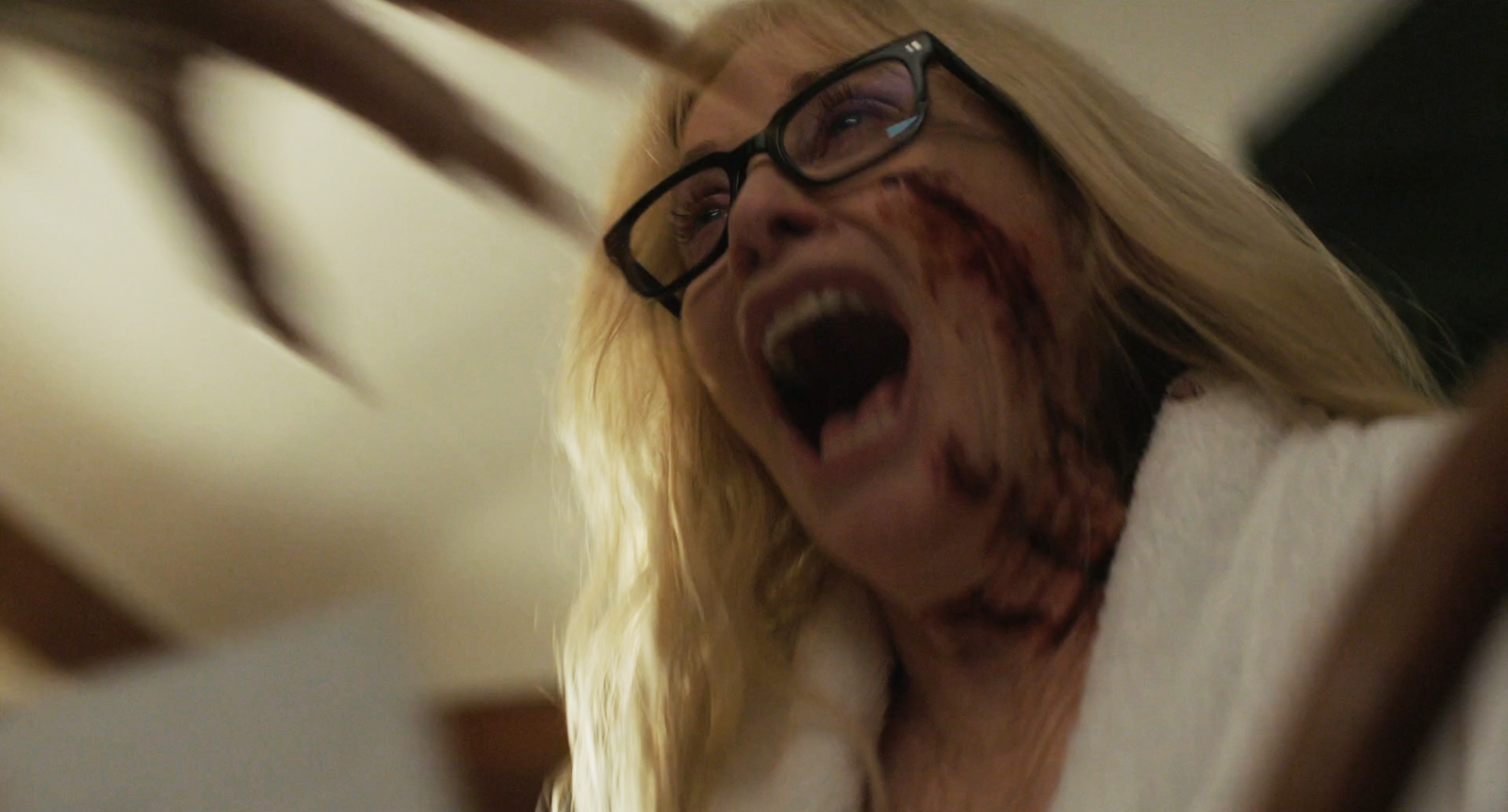
So the catastrophe plays out, in true Fessenden fashion. There’s violence on a budget, as blade-sharp claws swipe over faces, leaving bloody wounds. Digital effects are unpolished, as animated flies buzz unconvincingly and characters dart away as strangely pixelated blurs to suggest superspeed. There’s no doubt a lack of polish to what Fessenden’s grotesque visuals can accomplish, but that’s partly the charm. This ain’t An American Werewolf In London; Charley’s cosmetic makeup and fur stuffed under flannel shirts.
Unfortunately, Blackout is my least favorite of this specific quadrilogy, because I’d argue it plays the largest part. Still, Fessenden’s indie experience helps him navigate budgetary restrictions and keep Trauma or, Monsters All on track. There’s power behind monologues as everyone tries to make sense of unbelievable circumstances, keying into the depth of sorrow and solemnity behind stinging lines of dialogue. I’d argue Fessenden’s screenplay packs more bite than his fanged foes, which might be difficult for some to stomach, but ultimately is the unique hook that overrides rough-around-the-edges executions.
The question is simple: did you like any combination of Habit, Depraved, or Blackout? Splendid, Trauma Or, Monsters All is for you! Fessenden’s iconic independent horror voice is on display, as his under-the-radar monster series reaches its crescendo. He creates a world any audience can slide into: a rural creature feature built on humble intentions and honest depictions. Fessenden’s read on Universal’s legendary monsters is his own, drawing on themes of vulnerability and ostracization into our modern hellscape. Luckily, despite its blemishes, Trauma Or, Monsters All is a minimalist take on fabled figures with plenty to say, and another notch in Fessenden’s ever-mounting legacy.
3/5 Stars
Film Freak Central
Walter Chaw, April 21, 2026
***½/****
starring Laëtitia Hollard, Aitana Doyle, Addison Timlin, James Le Gros
written and directed by Larry Fessenden
There’s an immediacy to Larry Fessenden’s films, a lack of any intermediary between his characters and the viewer that can be exquisitely uncomfortable. Stories told through peepholes, they can feel like plays performed in a small venue, an intimate encounter ever threatening to spill over into the crowd. Credit his immersive, often suffocating sound design, an expertise demonstrated lately in his radio side project, “Tales from Beyond the Pale.” (I first saw Fessenden’s Habit on VHS, and the audio on its recent 4K upgrade is a revelation.) Credit also, of course, his sober, mature scripts, which deal with childhood, memory, and fear through the prism of fully formed, imperfect characters trapped in the amber of trauma that can’t be exorcised. For Fessenden, horror exists at the place where the visceral intersects with the philosophical–where the meat meets the mind. What happens to one when the other begins to develop fissures? When hairline cracks develop and let the sadness in? Consider the little boy (Erik Per Sullivan) in Fessenden’s masterful Wendigo, who learns one terrible winter that the shadow at the bottom of the stairs sometimes sees you even if you leap quietly, so quietly, across the top, where the light from the entryway paints a white square like a lepidopterist’s frame. Fessenden’s films are all variations on that species of terror, that variety of loneliness: its beginnings and endings and the long half-life in between, where fear metastasizes in unpredictable ways. He is a poet of the hard truth that being by yourself is the essential human condition.
Comprising a loose trilogy of riffs on Dracula, Frankenstein, and The Wolf Man, respectively, Fessenden’s Habit, Depraved, and Blackout understand the Universal Monsters pantheon as metaphors renewed for the generation that resurrects them and as modern archetypes that seem always to speak more eloquently in shorthand than in complete sentences. The vampire movie as a parable for addiction? Sure–but in Fessenden’s hands, the addiction is to destructive behaviours in toxic interpersonal relationships that erode self-esteem and social guardrails. I kept thinking of the character of Jack Torrance in The Shining when considering Habit‘s vampire, Sam (played by Fessenden himself). Both are alcoholics whose helplessness to their thirst results in the disintegration of their lives. When compared against the fevered, hunted eroticism in Fessenden’s work, what emerges is a sense that hunger (consummation) is the engine driving it. Fessenden’s carnality reminds of Abel Ferrara’s: smothering as much as smouldering; inescapably, scatalogically biological. I think there’s a relationship here, too, to David Cronenberg’s insectile communions; both Cronenberg and Fessenden approach fucking by documenting the human body functioning as a machine. The flesh is only wet meat, an insensate circuit of impulses and responses that carries within it a grey palimpsest pretending at art and philosophy. Cronenberg’s mad scientist Seth Brundle must “teach” his computer about the flesh to stop it from turning apes inside out. Fessenden’s films are the lessons learned. Literally so, in the case of one of his Frankenstein riffs, Depraved, which, like his werewolf film Blackout, begins with a couple enthusiastically in flagrante delicto, grounding this trilogy, Ken Russell-like, in the pros and cons of priapism.
Fessenden’s trilogy is coloured by melancholy and nostalgia. What I’m saying is that revisiting it upon the premiere of Fessenden’s latest at the Overlook Film Festival, Trauma or, Monsters All, proved a remarkable experience here in my dotage. Trauma or, Monsters All is, Douglas Adams-like, the fourth film in his monsters trilogy–a mash-up in the tradition of Ghost of Frankenstein or House of Dracula in which the aforementioned Sam, the Frankenstein’s monster of Depraved, Adam (Alex Breaux), and Blackout‘s werewolf, Charley (Alex Hurt), converge in the fictional Talbot Falls (christened in tribute to Lon Chaney Jr.’s Wolf Man, Larry Talbot). They’re drawn there by an article the conspicuously named Cassandra (Laëtitia Hollard) wrote for her college newspaper about the possibility that Talbot Falls’ recent run of bad luck is due to an infestation of cryptids. Adam and Charley already live there out of loneliness, while Sam is drawn there because if there are more outcast creatures like him lurking about somewhere, then that’s where he wants to be. It’s a film about middle-aged men in crisis, marooned from loved ones and isolated in oubliettes constructed of their terrible deeds and unresolvable regret. It’s heartbreaking by itself, but taken with the three earlier films, it looks very much like a masterpiece.
Trauma opens on a black screen, over which we hear a man talking about starting over after a string of disappointments. His friends are kind. They say supportive things about brand-new days and the promise of uncharted territory. When we finally see this man leaving the bar, he looks apprehensive but resolved. He walks to the parking lot. Lights a cigarette. And a monster kills him. This is Fessenden’s way with horror, real horror: the horror of hope; the horror of a life that will likely end in pain, and bring pain to those who will miss you. Horror is the root of religion, which offers a placebo for chaos that can feel capricious. Horror is realizing that you’re not beginning the rest of your life today. And what if you’re alone? What if, through no real fault of yours, you’re by yourself as the sand pools in the bottom of the glass? What if it was your fault, in a way, because you couldn’t control your rage of difference and dislocation?
Cassandra is working on a book about George Washington Carver, who you probably know, if you know of him at all, as the Black scientist who used peanuts in various applications. She wants to change how Carver is remembered. The task is frustrating: she feels like she keeps having the same conversations, fixing misconceptions, trainspotting microaggressions. You know, no one is accomplished enough to be remembered. No level of fame makes you immortal. In your lifetime, if you are unfortunate enough to live a long time, you will see the culture you have known your entire life become alien and strange. It is horror. Charley confronts Cassandra. He has to move on because of Cassandra’s article, and he’s furious, and wounded. He’s found a friend and a protector in Adam, who accepts him for who he is. Charley spends his time painting. He’s happy. He wants to be left alone. He tells Adam that he’s moving out, and Adam is destroyed. Charley visits the woman, Kate (Barbara Crampton), with whom he’s had an affair, but not as a lover: as a wolf. Charley’s storyline is like an episode of the extraordinary television series “The Incredible Hulk”, where a man loses control and must flee to a new place to begin again. And again. And again. This is Fessenden’s lycanthropy–a stand-in for masculinity and how we do a terrible job of teaching our young men to handle frustration. We do a terrible job of preparing anyone for grief. Charley only has violence to communicate, and Fessenden makes sure we see the atrocity of murder and then the ugly indignity of death. Crampton is one of the most beautiful people in horror, inside and out. It’s Fessenden’s emotional intelligence that causes him to identify her as someone it’s painful to see betrayed. As the song warns, you always hurt the one you love. If you’re a man, alas, sometimes you love them so much you kill them.
All of this leaves Cassandra targeted by the good people of Talbot Falls for digging up stories they’d rather stay buried. They’re an unpleasant bunch of drunkards and hypocrites involved in their own sagas of denial and self-medication; Talbot Falls is Small Town America circa 2026. There’s nothing special about it. It’s dying. We’re all dying. Cassandra’s best friend is pretty Sharon (Addison Timlin). One night, while trying to get a good look at Cassandra’s weird next-door neighbours, they share a sweet kiss. They don’t want to put a label on it. Cassandra has arrived at a delicate crossroads in her life. She’s finding her voice and discovering that the power that comes with it is double-edged. She’s exploring her sexuality and realizing she needs to take it slow. This is where regrets are formed. Left to fester, regret turns into trauma. It’s a terminal cancer or a fungal bloom. There’s a point at which you can no longer treat it. Trauma or, Monsters All is wisdom in all its multifoliate uselessness and horror. Fessenden is at the stage of his career now where he’s the elder statesman: the dispenser of advice, the creator of a body of work he’s stitched together here into a sad monster, shambling, sentient, alive…and beautiful. So beautiful. And brutal. Life is like that. I’m glad to be alive. I’m glad this film is, too.
Father, Son, Holy Gore
C.H. NEWELL, April 14, 2026
TRAUMA OR, MONSTERS ALL: An Exploration of Human Monstrosity
★★★★ (out of ★★★★★)
Trauma or, Monsters All, which premiered at the Overlook Film Festival this year, is another monstrous feature from director-writer Larry Fessenden, yet this film is even more unique than Fessenden’s previous work because it brings together monsters from three of his previous films—Habit (1995), Depraved (2019), and Blackout (2023)—to create a unified work about how monstrosity and humanity are tangled together. When a writer called Cassandra (Laetitia Hollard) has an article printed in the local newspaper in Talbot Falls about supposed monsters lurking around town, she unleashes buried traumas and fresh wounds which sets the town on edge and even against each other. As Cassandra attempts to find out the truth about the monsters, she only finds more pain, and it unfortunately puts her in danger, though it isn’t necessarily the danger posed by vampires, werewolves, and Frankensteins.
Not every horror filmmaker or writer understands the complexity of monstrosity, even if they make monster movies, but Fessenden—similar to someone like Guillermo del Toro—understands monsters; not only what makes them scary, but also what makes them deeply human. Trauma or, Monsters All deals with different ideas about monstrosity, particularly how what is monstrous can often, though not always, be in the eye of the beholder. Fessenden’s latest film is about resisting the monster within. It’s also just as much about not being trapped by the monstrosity of history. Like Cassandra, we must seek history’s complexities and truths, but we also must recognise that moving forward and healing is just as much, if not more, important, otherwise we’ll only ever be defined by monsters and the ghosts of our traumas.
Fessenden’s film, as evidenced by its title, tackles trauma on a community level while it also deals with personal traumas, too. Trauma often does one of two things: a) it makes someone stronger, or b) it makes someone even more susceptible to further traumas, which is where Talbot Falls finds itself as a community in the wake of the events in Blackout (2023), as well as the events in Depraved (2019) despite the latter not taking place directly in Talbot Falls. Fessenden has always had his finger on the pulse of America. Trauma or, Monsters All is a microcosm of a haunted America going through trauma after trauma without any time to heal. A wonderful piece throughout the film is Cassandra’s interest in George Washington Carver, whose name alone expresses the contradictions of American history. Cassandra mentions Carver’s interesting life, including his queer relationship with a younger white man, and recognises that even Carver, whose life was deeply affected by slavery, found ways to move beyond the defining racism of America. Fessenden’s film briefly touches on issues of race, ultimately taking the stance that race is one of the ways the powerful monsters in society keep us divided. In one scene, a character, perhaps unknowingly, even quotes the immortal words of Rodney King: “Can‘t we all just get along?”
Fessenden’s film deals with monsters and likewise with certain monstrous people in the small town of Talbot Falls. In one passing remark, we hear from the local librarian about the people trying to shut down or defund the library due to children’s books they don’t like. This itself is a direct reflection of the real America that Trump has ushered in, as MAGA roars about censorship while cheering on banning books that deal with queerness, trans identity, or Black history. There’s also Polidori who’s in from out of town, but still represents a very human monster; those who’ve seen Depravedalready know. But the most telling group of monsters are the angry white guys who all but hunt Cassandra because she wrote an article about the monstrous recent past of Talbot Falls; again, a real reflection of Trump’s America in which the enemies don’t seem to be the fascists or racists but the people trying to expose/deal with the nasty, violent truths of American history.
Trauma or, Monsters All also deals with the idea that human beings can, and so often do, become monsters, which speaks to a nature v. nurture concept of monstrosity; nobody’s born a monster, they’re shaped into one. The subplot involving Charley’s ex Sharon somewhat captures the spirit of Friedrich Nietzsche’s famous quote from Beyond Good and Evil (1886): “Whoever fights monsters should see to it that in the process he does not become a monster. And if you gaze long into an abyss, the abyss also gazes into you.” Sharon’s so lost due to Charley being cast out, because he’s seen as monstrous, that she winds up becoming a monster herself; her lingering trauma doesn’t allow her to see the monstrosity still around her, from the monstrous humans living in Talbot Falls to the literal vampire—Sam from Fessenden’s Habit, played by the director himself—who’s glided into town. Even if it’s not Sharon’s fault she becomes a monster, she still succumbs to genuine monstrosity, eventually committing a horrifying act of violence against a young queer woman.
Something important that Trauma or, Monsters All does is it brings to light that monstrosity is all about perception in the end. In one scene, Sam ruminates on monsters, “or just people who identify as monsters,” and then questions: “I mean, what is a monster?” Even if we go back to James Whale’s Frankenstein (1931) with the scene featuring Frankenstein and the little girl, we can see that monstrosity isn’t necessarily a reflection of reality, it’s more a reflection of the person looking upon what’s deemed ‘monstrous.’ That scene illustrates how those who are different are rightly afraid of being labelled monsters. This is why, in Trauma or, Monsters All, Adam (from Depraved) and Charley (from Blackout) are trying their best to hide away from the world, in order to avoid all the terror and violence that comes along with the label of monster.
In Fessenden’s film, even the most arguably ‘bad’ monster is aware of how humans are warped into monsters: “Y‘know, you‘ve gotta practice things like empathy and kindness, morality, all the virtues, and if you don‘t, they atrophy.” The real monsters in our societies today are those who turn their backs to empathy and kindness. We’re living in a time when some of the most powerful, wealthy people in the world say things like empathy is a “fundamental weakness of Western civilization.” Like Sam says, once your abilities to empathise and be kind atrophy, “then you become like the undead.” The genuine monsters living in our world circa 2026 are the rich and powerful, as well as those following them blindly, who’ve allowed their better hearts to die. By the end of Trauma or, Monsters All, new horrors and traumas have been visited upon Talbot Falls, and the monstrosity of everyday human beings is revealed. There’s at least a glimmer of hope that the truth will prevail and that good, honest people still remain, though Fessenden’s film makes clear that neither the truth nor goodness will survive if we don’t come together to save ourselves from the dangerous potentials of human monstrosity.
My New Orleans
Jeremy Marshall, April 15, 2026
Larry Fessenden’s “Trauma or Monsters All” is a unique creation; a culmination of three decades of quietly constructing a private universe of monsters ripped from the pages of “Famous Monsters of Filmland” that have taken root within the unique sensibilities of a filmmaker whose style belies easy explanation. As part four of his self styled “Quadrilogy”, the previous entries being “Habit”, “Depraved”, “Black Out”, Fessenden continues his streak of incepting his monster-verse with the prejudices and joys of reality; painting a canvas where monsters are merely a reflection of the ills that cannibalize polite society and a symptom of a much larger, more corrosive evil.
Seen in a four-movie marathon on the final day of the festival, Fessenden’s films are idiosyncratic in the sense that they are crafted for the delights of one person, himself. His monster movies are political; delving into the malaise of 90’s pre-war sludge, the after effects of the War on Terror upon a good doctor gone mad, and the ills of a community that prefers to blame an immigrant scapegoat instead of an American werewolf. For “Trauma or Monsters All”, Fessenden brings each of these flavors in red, white, and blue and stirs them together into a pestilence of kaleidoscopic sludge, tying the strings of history with fingers that touch the life of George Washington Carver, the experience of being the one black person in a city of suspicious whites, and even the value of eternal life if it is meant to be spent killing. Fessenden is eager to upend the toybox and smash the typical archetypes to pieces, using their base natures as a jumping-off point for stories that feel less scary than painfully earnest, and perhaps all the more lingering for their eagerness to be so.
While I would not suggest leaping into “Trauma or Monsters All” without priming yourself with the three films previous, I highly recommend slipping headfirst into the soup that Fessenden has served up for horror audiences over the course of a storied career. Here there be monsters, but also so much more.
Hollywood Reporter
Richard Newby, April 17, 2026
Horror Highlights from the 2026 Overlook Film Festival
The horror-centric fest featured a mix of big releases, streaming offerings and hidden gems looking for distribution.
Trauma, or Monsters All
Larry Fessenden, one of the premier voices in the indie horror scene, and a filmmaker who has inspired numerous others at this festival, closes out his monster quadrilogy with Trauma, or Monsters All. The film brings together the vampire Sam (Fessenden) from Habit (1995), Frankenstein of the Hudson, Adam (Alex Breaux) from Depraved(2019), and the wolf man of Talbot Falls, Charley (Alex Hurt) from Blackout (2023) for a monster mash nearly 30 years in the making. When a young biracial writer, Cassandra (Laetitia Hollard) moves to Talbot Falls to work on her book about revolutionary scientist and inventor George Washington Carver, she soon finds herself drawn towards the town’s local history and rumors of monsters after seeing a Frankenstein’s monster-like figure outside her bedroom window.
Compelled to dig deeper and report on her findings, Cassandra publishes an article about the town’s history, putting a target on her back for those who would rather ignore the past, and threatening the security of both Adam and Charley, who have found a mutual peace on the outskirts of town. Meanwhile, the vampire Sam comes into Talbot Falls after hearing of these other monsters and stirs up trouble by turning Charley’s beleaguered love-interest, Sharon (Addison Timlin), into a vampire. And the sinister Polidori (Joshua Leonard) returns to collect Adam, who he sees as his business asset. As Cassandra finds herself an outcast in her new home, and hunted by a racist group of ne’er-do-wells, and the monsters she exposed, she and her love interest, Agnes (Aitana Doyle) are forced to reexamine their responsibilities to history and themselves.
The film suggests we’ve become distracted by false enemies while the real monsters reside right in front of us, and in the highest seats of power in the country. While remembering our history is crucial, it’s the work of great individuals, like Carver, who we can turn to in an effort to better shape our future. There is revolution that can be found in science and art, and not simply the history of oppression in America. Trauma has shaped who we are as people and as a country, but in order to move forward, and truly change things, we’re going to have to let some of that go to heal and unite as a force that’s smarter and better equipped than the true monsters. Fessenden’s latest continues the threads begun with his first feature, and initial Frankenstein film, No Telling (1991), and offers, if not answers, then at least ideas on how to combat the modern horrors we’re all facing.
FANGORIA
Angel Melanson, April 16
Here’s Why The Overlook Film Festival Restored My Faith In Humanity
Rick Baker, the Crypt Keeper, Larry Fessenden, and a whole lot of popcorn. Another Overlook in the books.
by Angel Melanson
… Sunday was a full-on Larry Fessenden fest, celebrating the multi-hyphenate filmmaker’s World Premiere of his latest feature, Trauma, Or Monsters All. Overlook presented screenings of Fessenden’s Habit, Depraved, and Blackout (as seen on the cover of FANGORIA #22), culminating in Trauma, which serves as the ultimate Fessenden cinematic monster universe.
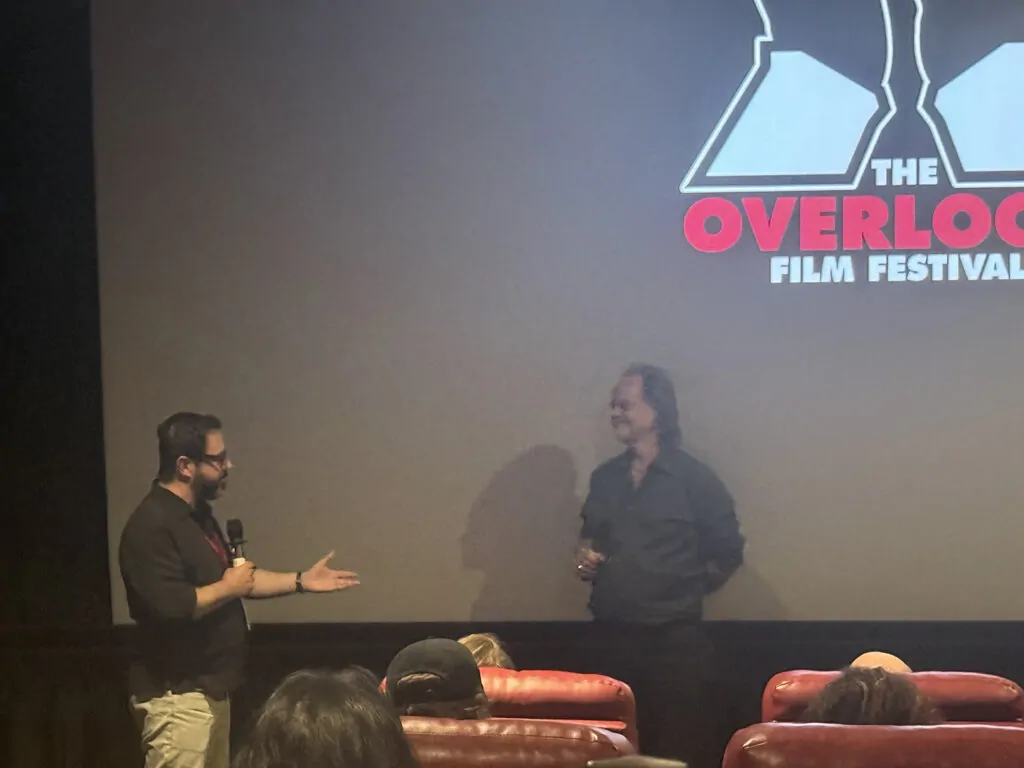
After each screening, Fessenden was present for a Q&A with Fango’s Phil Nobile Jr. and Kimberly Leszak. And not to get too dramatic here, but I feel comfortable sharing with you that I absolutely fell in love with Larry. His movies are full of monsters and messages that feel like a balm for the soul. Having the chance to hear him speak about them only solidified the weekend’s overall theme of restoring my faith in humanity.
FANGORIA
Phil Nobile Jr, April 17
Let Them Cook
By Phil Nobile Jr.
I had two utterly singular experiences at this year’s Overlook Film Festival: I interviewed the great Rick Baker about An American Werewolf in London for a Future Fango Thing; and I moderated a Q&A for Larry Fessenden’s “Monster Quadrilogy,” which screened his films Habit, Depraved and Blackout before his new one, Trauma or, Monsters All, which ties the aforementioned three films together in an audacious and surprising way.
In my interview with Mr. Baker, he talked about a frustration with the industry that led to his retirement a decade ago. I’m paraphrasing, but he said something along the lines of how, when you’re at the point where you’re getting notes from meddling producers about the shape of a monster’s eyebrow, or the placement of its nose, you realize you’re in a system where art and passion and creativity cannot exist, much less thrive. Mr. Baker decided that’s not where he wanted to be, and promptly dipped. Now, he’s still happily creating and blowing fans’ minds on Instagram, but he’s following his bliss instead of dopey producer feedback, and the beautiful work on his account emanates pure joy. “I retired from the business, I didn’t retire from being me,” he told us. Thank goodness for that.
Two days later was the Larry Fessenden marathon. Four films in a row, dating from 1996 to now. It was truly a privilege to see Larry’s work this way, back-to-back, watching not just the evolution of his style, but the evolution of indie genre filmmaking. And in watching Larry enjoy the absolute freedom he does — with form, with his own continuity, with the established rules of both horror and cinema itself — Mr. Baker’s comment about the producers who made him want to flee the movie industry rang in my ears.
I’ve written in this space before about Larry’s choice to use photos of his leading man Alex Hurt’s real father in 2024’s Blackout; that those photos are very clearly the late actor William Hurt is something one of Mr. Baker’s eyebrow-note-giving producers would have put a hand up over. But watching Blackout in sequence after Habit, one notices that Larry also did this with photos of his own father in that film and, William Hurt or no, he’s gonna follow his own rules. The choice not only works but resonates; Alex Hurt carries the same wounded quality that second-generation horror actor Lon Chaney Jr. did in The Wolf Man, and avowed Monster Kid Larry Fessenden surely clocked this. Anyone walking into The Wolf Man in 1941 was at least partly there to see a baton pass between generations, as the son of the great Lon Chaney claimed his birthright. (Sorta.) By placing those pics of the elder Hurt in the opening moments of his film, Larry takes that meta aspect to the next level, and it adds something special to the proceedings. And I know many, many producers who wouldn’t have let him.
The absence of unimaginative producer notes extends to Larry’s entire “Monsterverse” endeavor. A 30-years-later sequel to an indie classic might be expected to feel like a cash-in, or a safe bet, or resting on one’s laurels. But Larry, whose whole career has been about subverting expectations, somehow manages to make his monster mash a riskier endeavor than the three standalone films it pulls together. One can picture a version of Trauma or, Monsters All commissioned by a studio and overseen by money goons, and imagine all the ways it would not be the film Larry made. And I’m so grateful to get the movie Larry made, a vampire/werewolf/Frankenstein monster mash that is somehow also about Trump’s America, the death of empathy, and what happens when people (and monsters, as if there’s a difference in Larry’s films) shrug and give up being human. If you’re the kind of person entertained by ghoulish AI-rendered simulacra showing your favorite movie characters doing exactly what you tell them to, it might not be your thing. But if you’re excited by the organic, often unwieldy concept of true creativity, it’s good news that no one else is making movies like Larry Fessenden. We’re lucky to have him.
I say “lucky” because who knows what great talents and voices we never even got to hear because they were chewed up or chased off by non-creative execs who stomped on their creativity? How many more Rick Bakers should we lose to risk-averse bagmen who wander out of their lanes and think that signing a check means they know better than the person they’re paying? Rick Baker is not a waiter taking your order; he’s a chef, and you go to his restaurant to let him cook for you. Larry Fessenden is not an Uber driver going where you tell him to go; he’s an explorer on safari, and if you join the expedition, you do so with the faith that he knows the way, or is at least excited to discover the destination together. You may not be on board with the result — that’s part of exploring the unknown — but no one likes a backseat driver.
Variety
William Earl, August 5, 2026
Indie film icon Larry Fessenden is planning a monster mash — and it’s gearing up to be a graveyard smash.
The horror multi-hyphenate has just wrapped filming of his upcoming film — “Larry Fessenden’s Trauma Or, Monsters All” — and is heading into post-production, Variety can report exclusively. The film serves as a sequel to three other films he has written and directed: 1995’s vampire tale “Habit,” his 2019 “Frankenstein” riff “Depraved” and 2023 werewolf film “Blackout.”
“It was a slightly absurd mission to present my existential take on these monsters in a contemporary mash-up, but I enjoyed the challenge and I hope the film will feel both familiar and provocative,” Fessenden said in a statement, which also shared that he is “a lifelong fan of Universal Monster classics and the powerful messages about us that they can convey.”
Fessenden himself reprises the role of Sam from “Habit,” while Alex Breaux returns to portray Adam from “Depraved” and Alex Hurt revives his role as Charley from “Blackout.” According to the film’s logline, the story “places the filmmaker’s beloved visions of this trio of ghouls under one roof, offering up an unexpectedly humanist and uncanny tale.”
Also joining the cast are Laëtitia Hollard (“The Pitt”), Aitana Doyle (“If That Mockingbird Don’t Sing”) and returning actors from Fessenden’s past films, including Addison Timlin, James Le Gros, John Speredakos, Cody Kostro, Marc Senter, Rigo Garay, Joseph Castillo-Midyett, Joshua Leonard and Barbara Crampton.
“Larry Fessenden’s Trauma Or, Monsters All” is produced by Fessenden, Gaby Leyner, James Felix McKenney, and Tilson Allen-Merry for Glass Eye Pix. Stirling duBell and Chris Ingvordson also produce, with Edwin Linker as executive producer. Lois Drabkin handled casting on the film, which was shot by cinematographer Sharif El Neklawy.
This film marks Fessenden’s eighth directorial effort, and he has acted in over 100 films.
The Hollywood News
Kat Hughes, Aug 28, 2026
Larry Fessenden is a very familiar figure in the world of independent horror cinema. He is an actor that can be found in films such as We Are Still Here and Jakob’s Wife, but is also a producer with his company, Glass Eye Pix, and a director. Fessenden first began directing in 1978 when he started in short format films. Then, after honing his craft, Fessenden started directing features in 1991 with No Telling. His follow-up, Habit, has become a cult classic and has a very strong tie to his new movie, Trauma Or, Monsters All.
Throughout his career as a director, Larry Fessenden has explored several of the big movie monsters. Habit focused on vampirism, Depraved presented a modern day spin on Mary Shellley’s Frankenstein, and Blackout was Fessenden’s werewolf movie. Now, following in the path of the golden age of Universal monsters, Fessenden has thrown characters from all three films together for a monster mash.
Unlike the other movies in his insidious series, Trauma Or, Monsters All chooses to place a human into the role of protagonist. Set in the upstate New York town of Talbot Falls, Trauma Or, Monsters All joins new arrival Cassandra (Laëtitia Hollard). Originally moving to the town to work on her book about George Washington Carver, Cassandra is soon seduced by the town’s mysterious history. Then after encountering her strange looking neighbours, she writes a piece for the local newspaper about monsters, and in doing so, triggers the entire town, and places her as monster of the week.
At the same time that Cassandra is navigating small town hatred, Trauma Or, Monsters All catches up with the protagonists of both Depraved and Blackout. During the closing moments of Blackout, Depraved’s Adam was seen stumbling into frame. It appears that Adam scooped up wolfman Alex and the pair now live together as roommates, like the team in Being Human. Both creatures are still struggling to understand their place in the world, Adam still uneasy about his creation, and Alex trapped in anguish at having to leave his girlfriend behind. When news of the pair goes viral, it brings the curious vampire Sam to town, setting in motion a series of tragic events.
Whereas Fessenden’s previous entries in his monsterverse have focussed on the monsters themselves, the new onus on the human component makes for an interesting change up. Rather than placing these others as monsters, it instead shines a light on humanity’s proclivity for toxicity. The vitriol that the townsfolk spew towards Cassandra is horrendous, especially when her only crime is writing a story. That she also happens to be a person of colour and queer makes the treatment she receives feel terribly true to life. Fessenden uses his latest movie to hold a mirror up to society, and it isn’t a pretty picture.
Having his previous fictional creations threaded in around Cassandra’s story is a smart way to bring them in. A whole movie focussed on the trio would likely feel convoluted, and so having them acting as more as the sub plot is a great decision. It also means that it is not vital that the viewer has seen all, or any of, his past movies. Of course prior knowledge of the characters and their back stories leads to a richer viewing experience, but most importantly it does not alienate the new viewer. If anything, it generates intrigue as to the three shadowy figures and encourages the audience to seek out Fessenden’s back catalogue. Trauma Or, Monster All is a rare quadrilogy entry that can be viewed as either stand alone, the entry point, or ending. It is a fascinating and ingenious way to construct a film.
As with his other movies, Trauma Or, Monsters All is not fast and frenetic. Nor is it populated with gruesome kill after kill. Instead it is a slow-burn drama that highlights the humanity of its other beings, whilst demonstrating the viciousness of man. Those familiar with Fessenden’s other films may be expecting another round of near suffocating melancholy, but this new one deviates from that. Yes, Adam and Alex in particular remain sad boys, the inclusion of the vampish Sam, livens and lightens the tone. Fessenden is clearly having a ball revisiting the character and his performance brings the unhinged fun in spades. There is some great humour to be found in Sam, especially connected to vampire lore and the ageing process.
Both a fitting end and intriguing beginning for a group of characters that Larry Fessenden has spent thirty years working on, Trauma Or, Monsters All analyses the human condition through both the guise of people and monsters, generating some fascinating results.
SciFiNow
Anton Bitel Aug 28 2026
As a producer of indie horror and founder of Glass Eye Pix, a midwife and mentor to many other filmmakers, a writer, director, editor and actor in his own right, and a fan since childhood of the Universal monsters, Larry Fessenden has often visited these cinematic archetypes while giving them his own grounded, disarmingly modern spin. He himself starred as Sam in Habit (1997), his take on vampirism as a metaphor for addiction and overwhelming grief in New York City. Depraved (2019) updated the Frankenstein myth, again to contemporary New York. Blackout (2023) saw a conflicted werewolf preying on the fractured community of Talbot Falls in Upstate New York, and ended with its antihero Charley (Alex Hurt) walking past Adam (Alex Breaux), the piecemeal protagonist of Depraved, suggesting that all these stories might be unfolding in a shared, overlapping story world – something like Universal’s aborted Dark Universe, only with less big-budget spectacle and more mannered ruminations on the real world. This is confirmed in Fessenden’s latest, Trauma or, Monsters All, where Sam, Charley and Adam all come together in Talbot Falls, even if, as Polidori (Joshua Leonard) puts it, there is “no AI here,” just flesh-and-blood practical effects and big ideas about the state of the nation.
Cassandra (Laëtitia Hollard) came three months ago to Talbot Falls, ironically for the peace and quiet. Staying in the cheapest rental home she could find on the town’s outskirts in Cedar Grove, she is a historian working on a book about the African-American scientist George Washington Carver, focusing on the multifacetedness of a man whom she describes to her new friend Agnes (Aitana Doyle) as “so uniquely himself”, as well as on the contradictions that his life story exposed in America. Yet Cassandra will get distracted from her work by a growling sound coming from the locked basement of the house next door, and by the more recent local history that she starts uncovering and writing up. The resulting piece, “Are there monsters outside my window?”, is published in Talbot Falls’ newspaper and of course online, attracting attention not just from all kinds of locals with different axes to grind, but from others further afield.
Polidori is looking for Adam to exploit him, Charley’s ex Sharon (Addison Timlin) and his old friends Miguel (Rigo Garay) and Pastor Francis (John Speredakos) just want to see again the man they once held dear, while policemen Tom Granick (James LeGros) and Luis Sanchez (Joseph Castillo-Midyett) are looking for revenge. The young white bigots Burt and Ernie (Cody Kostro, Marc Senter) – whose very names are suggestive of their closetedness – seem to reserve as much ire against the presence of Black female outsider Cassandra as of real-life monsters, and local lawyer Kate (Barbara Crampton) is in her own way preying on the community’s young men. In the meantime, the still very much active, still blood-sucking Sam (played again, some three decades later, by Fessenden) has heard about Cassandra’s article, and come Upstate from his hunting grounds in the City, ‘curious’ to meet other monsters and to have what he describes as a “mad Mad Monster Party”.
“I’m kind of a monster too, you wanna interview me?” says a barista, flashing her ‘TRANS’ tattoo at Cassandra. It is an acknowledgment, already encoded in the film’s title, that everyone here is a monster, whether through the Otherness of being non-white, female, or queer (Cassandra is all three, and in one highly self-conscious moment, states out loud that she cannot tell if she is in “a lesbian movie or a monster movie”), or through being the opposite of those and aggressively enforcing one’s white, male, heteronormative values on others, or indeed through being something like the Universal monsters, as conflicted and complicated, which is to say as human, as all the other characters in the film.
The history that Cassandra is exploring turns out to run in parallel with what is still unfolding in this community, which, though small, is full of stark divisions and unresolved traumas, making it a microcosm of America. “I wanna believe that Talbot Falls can heal itself by facing its demons,” Cassandra will say early on, “And if Talbot Falls can, maybe all of us can.” This potentially optimistic view of a better future emerging from America’s messed-up, monstrous present remains an open question, in a film that repeatedly plays upon the association of Cassandra’s name with the mythic Trojan priestess doomed to see her (accurate) prognostications go unheeded. “My parents say they named me Cassandra,” she says, “because it’s not what you know but how you communicate it.” Fessenden, of course, communicates his sociopolitical message through an entertaining ensemble monster movie format, trusting that the allegory will not fall on deaf ears.
Perhaps the last word on the nation’s Trumpian status quo and post-Trumpian prospects should go to Fessenden’s Sam, who got this whole cycle of films rolling thirty years ago. “You’ve gotta practise things like empathy, kindness, morality, all the virtues, and if you don’t, they atrophy,” he says. “I see it every day: hope becomes an effort, and you stop believing in tomorrow, and you become like the undead.… But you know what it is, it’s really the unalive.” It takes Sam – whose appearance at times merges with that of shadowy, hairless, bat-eared Orlok from Murnau’s Nosferatu (1922), and whose high-angle finger pointing tracked in one scene by the camera parodies a similar sequence from Robert Eggers’ 2024 remake, to recognise those in his country who have allowed themselves to become disengaged, callous and cruel as the real monsters.
TRAUMA is a continuation of multiple themes that Fessenden has explored in a series of revisionist, present-day interpretations of familiar horror archetypes. His 1995 vampire film HABIT explores loneliness, alienation and addiction in New York city in the 1990s. HABIT went on to earn Fessenden the Someone to Watch Award and two Spirit Award Nominations. In 2019 he released DEPRAVED, a retelling of Mary Shelley’s Frankenstein set in a Brooklyn loft. A field Surgeon suffering from PTSD after a tour of duty in Iraq strives to make a man out of body parts collected by his nefarious benefactor, an opportunistic pharmaceutical entrepreneur. DEPRAVED explores identity, memory, science and parenthood in a sweeping and heartbreaking rendition of the timeless classic. Fessenden followed this with BLACKOUT (2022), a film comparing alcoholism with the werewolf affliction in a tale set in an upstate hamlet that blames a spate of brutal killings on the local immigrant community. Fessenden again delves into the social stresses of the times with a humanist response. TRAUMA stands as a summation of the various themes explored in the trilogy of films, reuniting characters from all three movies to tell a new story about the fundamental difficulty of finding a common narrative to give meaning and consensus in the modern world.
DIRECTOR’S STATEMENT: Since the 90’s I have been reinterpreting classic horror movie tropes with a deep desire to peel back the artifice and find some truth in their stories while maintaining the wonder and supernatural awe of these modern myths. I always asked the question “what would it really be like” — to meet a vampire, (HABIT, 1997) to wake up a Frankenstein monster (DEPRAVED, 2018), to be a werewolf (BLACKOUT, 2022). At the same time my own preoccupation with the political and philosophical implications intrinsic to horror has kept my approach decidedly niche: less scares, more melancholy and dread. Despite that I offer this sequel to movies few have seen as a continuation of my personal mission to understand the monsters among us.
While making BLACKOUT I would joke that my next project would feature the three monsters I had previously created, all in a single film as Universal Studios did in the 1940s to cash in on the popularity of their iconic films DRACULA, FRANKENSTEIN and WOLF MAN. They made four such mashups, culminating in the comedy ABBOT AND COSTELLO MEET FRANKENSTEIN. My task would be to take my own tonal approach and find a scenario to bring these disparate characters together. My thought was to depart from the first-person strategy of my previous movies which humanized the monsters, and instead, objectify them. For that I would need a new protagonist who would observe the monsters from her window: Cassandra, referencing the myth of a goddess who saw but was not believed.
PRE-PRODUCTION: My initial references were REAR WINDOW and FRIGHT NIGHT and MONSTER SQUAD and AMERICAN BEAUTY for their use of voyeurism, but in conjuring up my new main character, I drew from old themes of the monster as outsider, the fundamental feeling of alienation we all experience, and the contemporary preoccupation with identity politics and its backlash. I also wanted to tribute a certain hero of mine, the environmentalist George Washington Carver, and though it may not work for the viewer looking for a straight horror story, this mix of ideas all tracked in my mind as an exploration of individualism. Once I finished the first draft of the script, I was determined to get into production. My great challenge was first, the casting of the two new leads and second, getting back the players from all the old films. Luckily, I at least, was available to play Sam from HABIT.
Lois Drabkin, who had cast three features for Glass Eye Pix previously, was an essential collaborator in finding the two new leads. Lois had seen Laëtitia Hollard in a performance at Julliard and invited her to read the script. Upon meeting Laëtitia, I cast her immediately, inspired by her deep connection to the character Cassandra. Lois also found Aitana Doyle for Agnes. I cast Doyle for her humor and savvy as soon as I met her. Perhaps the harder task was lining up all the old favorites without whom this sequel would have no gravitas: Alex Hurt had to return as the Werewolf; Alex Breaux, my Frankenstein Monster from DEPRAVED, was performing in STRANGER THINGS on Broadway and was unavailable to shoot except on Mondays, and even that was frowned upon by his theatrical overlords. Joshua Leonard had to be pulled out of retirement. Addison Timlin had to return to play the “bride of the monster” one more time. Every surviving denizen of Talbot Falls had to reprieve their roles to complete the series.
I had been prepping the movie almost from the conclusion of BLACKOUT, feeling somehow if it didn’t happen right away, it would never happen. I began searching for the impossibly specific location at the center of the film: two adjacent houses. This took six months at least and yet the solution came about so randomly, a reminder of the synchronicity at play in filmmaking. To be clear I mean low-budget filmmaking: We didn’t solve the problem with money, we didn’t build a set, or pay off a neighborhood. We found the spot and made a deal, and it was one mile from HQ all along.
THE SHOOT: I had a great crew led by Cinematographer Sharif El Neklawy. Creature design was orchestrated by long time collaborators Brian Spears and Peter Gerner who were tasked with embellishing their own work from the past films. We decided to enhance our werewolf design to reference an image from the previous movie, and just to try something different. Bringing Sam from HABIT back was a strange challenge. Fans of the old film may question the logic of his return, but with all horror tropes, I like to remind viewers that the rules in fantasy stories are no more reliable than the rules that govern our society. Money, laws, norms— they are all tenuous, built on social contracts (and careful if any one person or political party were to come along and simply ignore the most basic assumptions on which we’ve built our society!). And so I thrive on discord in my genre stories to remind the viewer that our grip on reality is a construct in itself.
The shoot went on and off for three months because of the actors’ schedules. Not that we had a lot of days, they were just spread out. We shot fast. I have a somewhat punk aesthetic with filmmaking: As carefully mapped out as a Hitchcock film, shot as quick as a mumblecore movie.
POST: I put together the cut fairly quickly as everything was predesigned and we didn’t have time to shoot alternative coverage; I was delighted by the actors’ commitment and unwilling to cut for time. This is a movie about ideas and conversations that run long. It is a movie about communication and its breakdown. But anyway, after there’s a cut, it’s the tweaks and sound that takes time. I spent much of post-production collaborating with visual effects artist Eugen Lehnert who created over 30 embellishments to the existing images.
The paintings were again handled by John Mitchell from BLACKOUT in collaboration with Anki King. We animated their process as they created Charley’s basement. The images offer clues as to Charley’s psyche and the trauma he has endured as a werewolf in hiding, struggling with the memory of his love and transgressions.
I invited animator Beck Underwood (THE LURE OF PONIES, CREEPY CHRISTMAS FILM FESTIVAL) to create the werewolf transformation in the basement using live action stop motion, an update of the technique used in the earliest Universal Studios Wolfman movies.
For the music I chose to employ themes composer Will Bates had created for BLACKOUT and DEPRAVED, giving those monsters a leitmotif. I also used excerpts from the gorgeous score to HABIT by Geoffrey Kidde. And then Bates created new pieces for TRAUMA to connect us to the Cassandra and Agnes story and unify the music-scape. I invited long-time collaborator Graham Reznick to contribute a drone score, creating a sense of unease in even the most mundane sequences: the uncanny in the everyday. Finally, I used songs by Just Desserts, my band lead by songwriter Tom Laverack who has provided his melancholy melodies to all my films since the 80s.
As for the folly of making a sequel to movies few people have seen, I never sought to lean on the back-stories in the current film. They are referenced like hear-say, memories lost, local lore, gossip, all the things that haunt our psyche and our shared history. This is the trauma we all carry with us, societal and personal. This movie is about ghosts, memory, psychic wounds, and of course, it is about identity— how we talk about each other, how we define each other. If my work is political at all, this movie is a defiant call for old fashioned humanism, to see everyone as an individual.
But luckily in the end TRAUMA is just a monster movie, for we are… Monsters All.
KEY PERSONEL
GABY LEYNER (PRODUCER) is a New York based independent producer with a focus on daring, director-driven storytelling. She produced BLACKOUT, the seventh feature from horror auteur Larry Fessenden, which premiered at Fantasia and Sitges ‘23, in collaboration with Glass Eye Pix. She is also producer of Trauma or, Monsters All, Fessenden’s monster mash-up and sequel to Habit, Depraved and Blackout. Her additional credits include EUGENE THE MARINE, a Giallo-inspired thriller directed by Hank Bedford and starring Scott Glenn, Jim Gaffigan, and Shioli Kutsuna. Leyner also serves as Executive Producer on THE DREADFUL, the Lionsgate British gothic horror film from director Natasha Kermani, starring Sophie Turner, Kit Harington, and Marcia Gay Harden.
JAMES FELIX McKENNEY (PRODUCER) is an independent filmmaker known for his unusual and innovative genre films including HYPOTHERMIA starring Michael Rooker (GUARDIANS OF THE GALAXY 1 & 2, THE SUICIDE SQUAD) for Dark Sky Films, SATAN HATES YOU for Glass Eye Pix and the critically acclaimed low-fi sci-fi film AUTOMATONS. Over the years, James has worked in live theatre, written, edited, and published comic books, created designer toys, hosted podcasts and radio shows, designed T-shirts, and more. But filmmaking continues to be his first and greatest love. His latest feature, the post-apocalyptic experiment, WRACK, was released in 2022 via his Channel Midnight Releasing label.
TILSON ALLEN-MERRY (PRODUCER) is a Brooklyn based independent film and commercial producer. Originally from Jacksonville, Florida, he moved to New York in 2011 after receiving a BA in Film Studies from the University of Florida. He was the Festival Producer of Newfest from 2015-17, and a Features Programmer at the Tribeca Film Festival from 2016-17. Feature film credits include CRUMB CATCHER (2023), FAMILIAR TOUCH (2024) and IRREGULAR.
LOIS DRABKIN (CASTING) is a Casting Director who has worked extensively on a range of projects, most notably in independent film, including: the Sundance premieres NANCY, LISTEN UP PHILIP, RESTLESS CITY, NIGHT CATCHES US, and THE MISSING PERSON; the Independent Spirit Award acting-nominated features COLEWELL (Karen Allen), NANCY (J. Smith-Cameron) and GLASS CHIN (Marin Ireland); and the future releases of Indiewire Young Filmmaker to Watch Jack Fessenden’s FOXHOLE, and Harry Greenberger’s FARAWAY EYES, with Christina Ricci and Andy Karl. Additional credits include the first season of the 2014 Emmy- winning Showtime documentary series investigating climate change, YEARS OF LIVING DANGEROUSLY, and as part of the casting teams for Steven Spielberg’s WAR OF THE WORLDS, the acclaimed HBO series THE WIRE, and Michael Mann’s PUBLIC ENEMIES. A member of the Casting Society of America, Lois has been nominated for multiple Artios Awards for Outstanding Casting.
SHARIF EL NEKLAWY (CINEMATOGRAPHY) is an American filmmaker who has been based in Brooklyn, NY for 10 years and has experience Directing, Editing and Producing, but has always prioritized camera work since getting his BA in film production at Emerson College in Boston, MA. Has been a dedicated DP and Camera Operator since 2015 after spending 4 years working as an AC, working his way up to becoming a full-time DP. Clients include Comedy Central, GQ, Vanity Fair, Teen Vogue, Vogue China, Wired Magazine, Tom Ford, Olay, Pepsi, Sprite, Coca-Cola, Bacardi, Instagram, Facebook, Twitter, Giphy, Samsung, Virgin, MoMa, Everytown for Gun Safety, Planned Parenthood, Naral, ACLU and many more. Production Companies include Ghost Robot, Neighborhood Watch, Hardpin Media, Resonant Pictures and many more.
THOMAS SLATTERY (PRODUCTION DESIGN) is a New York City based production designer and art director working primarily in film. He recently designed Beatriz Calleja’s ARTIFACTS, and in 2025 art directed the romantic drama ANCIENT HISTORY and 90s set horror film CORPUS. He is currently designing a New York based romantic comedy and developing independent horror comics.
HANNAH KITTELL (COSTUME DESIGN) has designed costumes for films MOLLI AND MAX IN THE FUTURE, KATE PLAYS CHRISTINE, THIS CLOSENESS, and 流浪地球2 (The Wandering Earth II), series Pixar in Real Life and The Fall of Diddy, advertising for The New York Rangers, Dunkin’ (a personal career high point as a native New Englander), Lego, and Petsmart, music videos for Bad Bunny, J Balvin, and Thalia, and costumes for private clients such as Adam Savage of Mythbusters. Currently, she is producing a new original romantic comedy feature, and working on her debut novel, a queer romance about Cold War spies.
BRIAN SPEARS (MAKEUP EFFECTS) is a prosthetic make-up artist who’s made a career creating monstrosities, murders and so much more for over 20 years. There is no budget too high or low he will not give his all creating something memorable and iconic using a slab of clay and a bunch of brushes. For the better part of a decade Spears has contributed to countless gigs in the New York area. The hard work is paying off: recently his work for Goosebumps: The Vanishing was nominated for a Makeup & Hairstylist Guild Award in the category best makeup for a children/teen program. Other credits include Army of the Dead, Orange is the New Black, Daredevil, The Punisher, Servant , Companion and The Smile films. Spears, along with Pete Gerner are no strangers to the Larry Fessenden Monsterverse and howled at the chance to create the creatures of TRAUMA. The duo previously brought life to the monsters in Larry’s brain for DEPRAVED and BLACKOUT. Gerner and Spears first worked with Glass Eye Pix on the epic I SELL THE DEAD, soon after they contributed to a slew of other GEP flicks including- STAKELAND, THE INNKEEPERS, STRAY BULLETS, BENEATH and The RANGER. Spears is grateful for anytime he can be on a Glass Eye show because it is creative, feels like family and artistically it keeps him on his toes. Spears achieved his greatest career highlight due to his dabbling with GEP… the makeup created for Blackout, the wolfman, landed the cover of Fangoria magazine.
EUGENE LEHNERT (VISUAL EFFECTS) is a New York–based filmmaker and visual effects artist whose work spans feature films, television, and independent projects. He has collaborated with clients including HBO, Netflix, and Criterion, contributing to everything from restorations of classic films to original productions. With a background in post-production and a love of storytelling, Eugene approaches visual effects as a way to quietly support the story—whether that means making the impossible feel real or simply helping a moment land just right. In his free time, he can occasionally be found hunting the Gowanus monster in the outer boroughs—strictly for research purposes.
WILL BATES (MUSIC) is an award-winning composer, multi-instrumentalist and founder of music and audio post production company Fall On Your Sword. He recently scored Daniel Roher’s TUNER; and Alex Gibney’s KNIFE: THE ATTEMPTED MURDER OF SALMAN RUSHDIE, which premiered at the 2026 Sundance Film Festival. Bates has composed original scores for a myriad of filmmakers including acclaimed directors Alex Gibney (WE STEAL SECRETS: THE STORY OF WIKILEAKS; GOING CLEAR: SCIENTOLOGY AND THE PRISON OF BELIEF; ZERO DAYS; THE FOREVER PRISONER), Mike Cahill (ANOTHER EARTH; I ORIGINS; BLISS) and Craig Gillespie (The Better Sister; DUMB MONEY). Film and television credits include Rob Burnett’s IN MEMORIAM; Paramount+’s NCIS: Tony & Ziva; Apple TV+’s documentary feature film STILLER & MEARA: NOTHING IS LOST; Eric Lin’s ROSEMEAD; Hulu’s two-part documentary tv series Call Her Alex; Netflix’s THE LIFE LIST; NEON’s IMMACULATE; FX’s Class of ’09; AMC+’s Anne Rice’s Mayfair Witches; Netflix’s mini-series Devil in Ohio; Starz’s Sweetbitter; the Golden Globe and Emmy-nominated Netflix mini-series Unbelievable; and more.
GRAHAM REZNICK (DRONE SCORE) is a writer, director sound designer and musician. Director of I CAN SEE YOU (2008), the Shudder series DEADWAX (2018), and co-author of the Bafta-winning video game UNTIL DAWN, he went on to pen more video games including MAN OF MEDAN and THE QUARRY. Reznick has sound designed many films for Glass Eye Pix including THE ROOST, THE HOUSE OF THE DEVIL, THE INNKEEPERS, STAKE LAND, I SELL THE DEAD, and BENEATH. Reznick was sound designer on the celebrated 2025 film RABBIT TRAP with Dev Patel and Rosy McEwen. Reznick also records albums and has contributed to Glass Eye Pix’s Tales From Beyond The Pale and The Creepy Christmas Film Festival.
JUST DESSERTS (SONGS) & TOM LAVERACK ‘Curtains‘ is the fourth full length album from ‘Just Desserts,’ a NYC duo that has made music since 1977, playing clubs like CBBs, Mercury Lounge, Knitting Factory, Rodeo Bar, Pyramid Club, etc. while recording albums, EPs and Singles along the way. Fessenden is one half of the duo, while Tom Laverack is the other half. He is a singer-songwriter, co-owner of Sojourn Records, and former social worker. Laverack has released four solo albums, he dabbles in writing prose and poetry and is excellent at Excel. Laverack composed the orchestral score for Fessenden’s 1990 film NO TELLING, and went on to write songs for NO TELLING, HABIT, WENDIGO, THE LAST WINTER, DEPRAVED and BLACKOUT.
LAËTITIA HOLLARD (Cassandra) can be seen in the second season of the highly acclaimed Emmy award winning HBO Max medical drama series THE PITT as well as Larry Fessenden’s TRAUMA OR, MONSTERS ALL. She is a multilingual actor, singer, and recent graduate of The Juilliard School Drama Division. At Juilliard, she delved into theatre with roles in Twelfth Night (Viola), Abingdon Square (Mary), and Antony and Cleopatra (Cleopatra). Originally from Wisconsin, Laëtitia began performing with the Children’s Theatre of Madison and Capital City Theatre. She has developed new work with Coachella Valley Repertory Theatre, Hunter College, and R18 Collective. Fluent in French, and with proficiency in Guadeloupean Creole, Spanish, and Portuguese while also being skilled in a range of musical instruments and dance forms, Laëtitia brings a global perspective and physical storytelling style to her work. Her honors include the Moni Yakim Scholarship, the Gold Presidential Volunteer Service Award, and multiple Martin Luther King Jr. Awards for Excellence.
AITANA DOYLE (Agnes)is a Spanish-American actress based in NYC. She recently wrapped the indie feature SLYBOOTS from Emma Broadbent and Shae Sennett, in which she stars. Aitana will next be seen starring in Larry Fessenden’s horror film, TRAUMA OR, MONSTERS ALL. A graduate of UNCSA, her credits include the play MARY’S WEDDING directed by Kelly Maxner and the lead in Sadie Corrigan’s debut feature film IF THAT MOCKINGBIRD DON’T SING.
ADDISON TIMLIN, (Sharon) began her career with the 2000-01 National Tour of “Annie”. She performed every orphan role before taking over the role of Annie when she was 9 years old. Her love of stage continued to several productions of Annie including Papermill Playhouse and the Theater of The Stars Tour alongside John Schuck before going on to Broadway as Baby Louise in “Gypsy” with Bernadette Peters. Timlin was seen in the film “Isabel Fish”, directed by Lara Zizic for the Columbia Film Festival.
ALEX HURT (Charley) Alex Hurt is known for MINYAN (2020), BONDING (2018) and THE GOOD FIGHT (2017). For Glass Eye Pix Hurt has appeared in Jack Fessenden’s FOXHOLE and Larry Fessenden’s BLACKOUT.
ALEX BREAUX (Adam) played as Olympic swimmer Ray in the New York Theatre Workshop stage play Red Speedo, and then appearing in the film JOSEPHINE, KATIE SAYS GOODBYE and BUSHWICK. Television work includes Waco: The Aftermath (as domestic terrorist Timothy McVeigh), The Blacklist, Law & Order: Special Victims Unit, The Equalizer, Joe Pickett and Blue Bloods. and played the recurring role of Lieutenant Robert Akers in the Netflix final season of Stranger Things. For the last year he has been in STRANGER THINGS on Broadway. He has appeared in the Glass Eye Pix films DEPRAVED and Jack Fessenden’s FOXHOLE.
JOHN SPEREDAKOS (Father Francis) was born on August 11, 1962 in New York City, New York, USA. He is an actor, known for THE MIND’S EYE (2015), WENDIGO (2001) INSIDE MAN (2006), CRUMB CATCHER (2023) and BLACKOUT (2023).
MARC SENTER (Ernie) is known for THE LOST (2006), THE DEVIL’S CARNIVAL (2012) and STARRY EYES (2014) and COWBOY (2025). He is a producer on several recent films including OLD MAN and COWBOY.
CODY KOSTRO (Burt) is known for HARVEST BOWL (2021), I’M RAPPER GIRLFRIEND (2020) and MARE OF EASTTOWN (2021).
MICHEÁL NEESON (Blaze) is an Irish actor and the son of actors Liam Neeson and Natasha Richardson. He has appeared in Cold Pursuit. Neeson has also worked in fashion, interning at Celine and Savile Row, and curating a fashion gallery. He launched his own charitable clothing line, Pine Outfitters, which is eco-friendly.
JOSEPH CASTILLO-MIDYETT, (Luis) is known for THE ENDGAME (2022), THE EQUALIZER (2021) and DEATH SAVED MY LIFE (2021).
RIGO GARAY (Miguel) is known for CRUMB CATCHER, THE LEECH (2022), and BLACKOUT (2023) and numerous shorts including SIZE UP which he wrote and directed.
TOBY POSER (Burt’s Mom) is a film and theater actor, writer, director, producer, and voice over artist. She was born in Huntingdon, PA and lives in both New York and California with her creative partner and husband, John Adams, and their daughters, Lulu and Zelda Adams. Together they have made the DIY masterworks HELLBENDER, THE DEEPER YOU DIG. MOTHER OF FLIES and WHERE THE DEVIL ROAMS.
EMILY BENNETT (Karen) is an actress and director whose recent film BLOOD SHINE will be released by MPI Dark Sky Films in the Spring of 2026.
JOSHUA LEONARD, (Polidori) is an American actor, producer, writer, and director, known for his role in THE BLAIR WITCH PROJECT (1999). He has since starred in films such as MADHOUSE (2004), THE SHAGGY DOG (2006), HIGHER GROUND (2011), THE MOTEL LIFE (2012), SNAKE AND MONGOOSE (2013), IF I STAY (2014), THE TOWN THAT DREADED SUNDOWN (2014), 6 YEARS (2015), and UNSANE (2018).
BARBARA CRAMPTON (Kate) is an American actress and producer. She began her career in the 1980s in television soap operas before starring in horror and thriller films. She made her film debut in BODY DOUBLE (1984), but received recognition in the comedy horror film RE-ANIMATOR (1985) and the science-fiction film FROM BEYOND (1986). Her later defining roles include CHOPPING MALL (1986), PUPPET MASTER (1989), CASTLE FREAK (1995), YOU’RE NEXT (2011), WE ARE STILL HERE (2015), LITTLE SISTER (2016), PUPPET MASTER: THE LITTLEST REICH (2018), and JAKOB’S WIFE (2021), which she also produced and for which she was nominated for Critics’ Choice Super Awards.
JAMES LE GROS (Tom Granick) starred in Gus Van Sant’s film DRUGSTORE COWBOY and LIVING IN OBLIVION, where he played Chad Palomino, a self-centered actor demands for a “b-movie” director. He starred with Patrick Swayze and Keanu Reeves in the 1991 film POINT BREAK. Le Gros has appeared on Showtime’s Sleeper Cell and on Law & Order, Ally McBeal, Roseanne, Punky Brewster, The Outer Limits, and Friends. He has been in films by Kelly Reichardt and numerous Glass Eye Pix productions including THE LAST WINTER, BITTER FEAST, STRAY BULLETS, FOXHOLE and BLACKOUT.